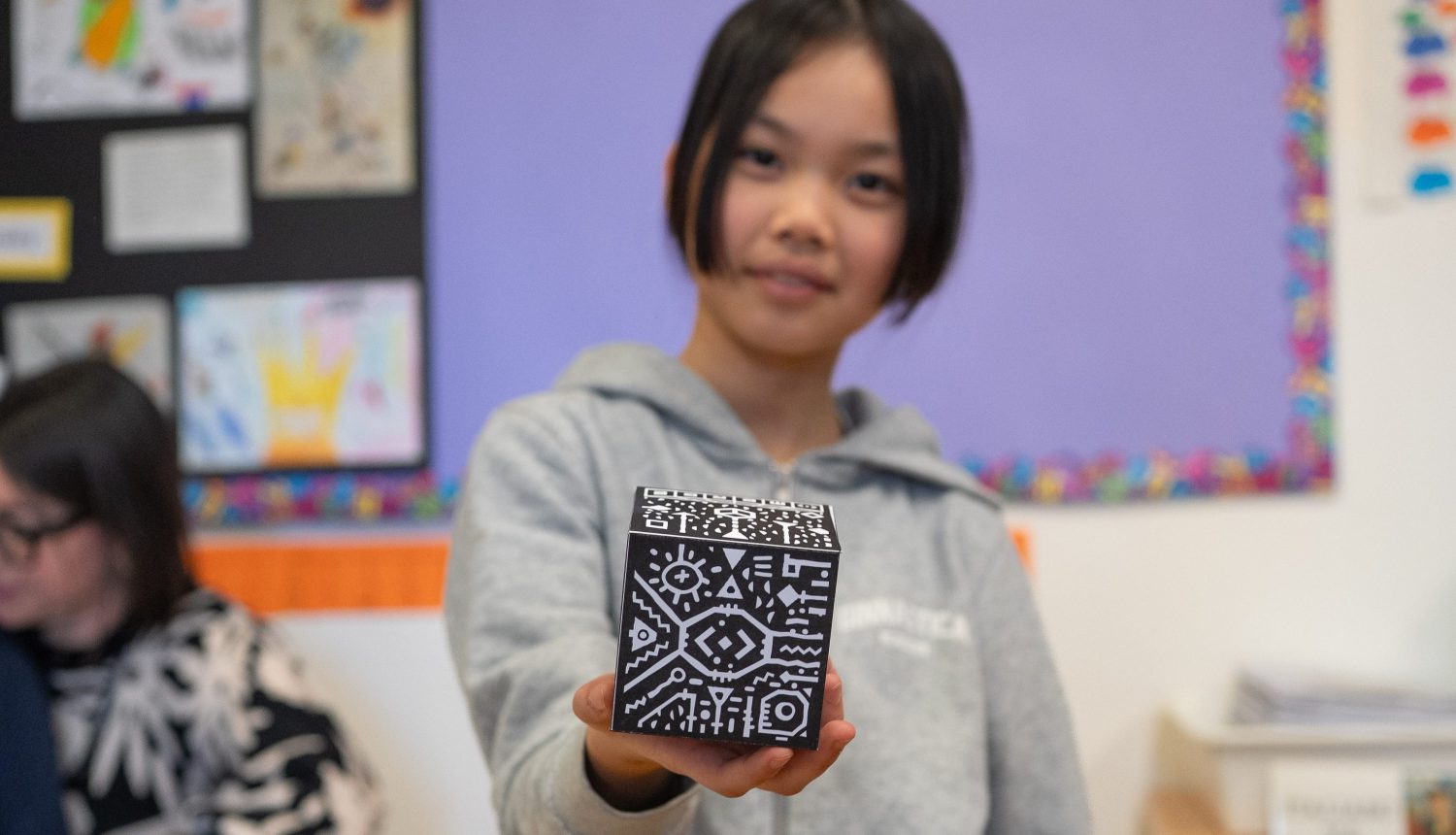
A small cube in the palm of a student’s hand.
At first glance, it looks like a simple object. But when a tablet frames it, a museum appears: rooms, artworks, and characters guiding visitors through the exhibition. Each student designed their own digital space, complete with AI Buddies: interactive guides that answer questions and help visitors explore the artworks inside the virtual gallery.
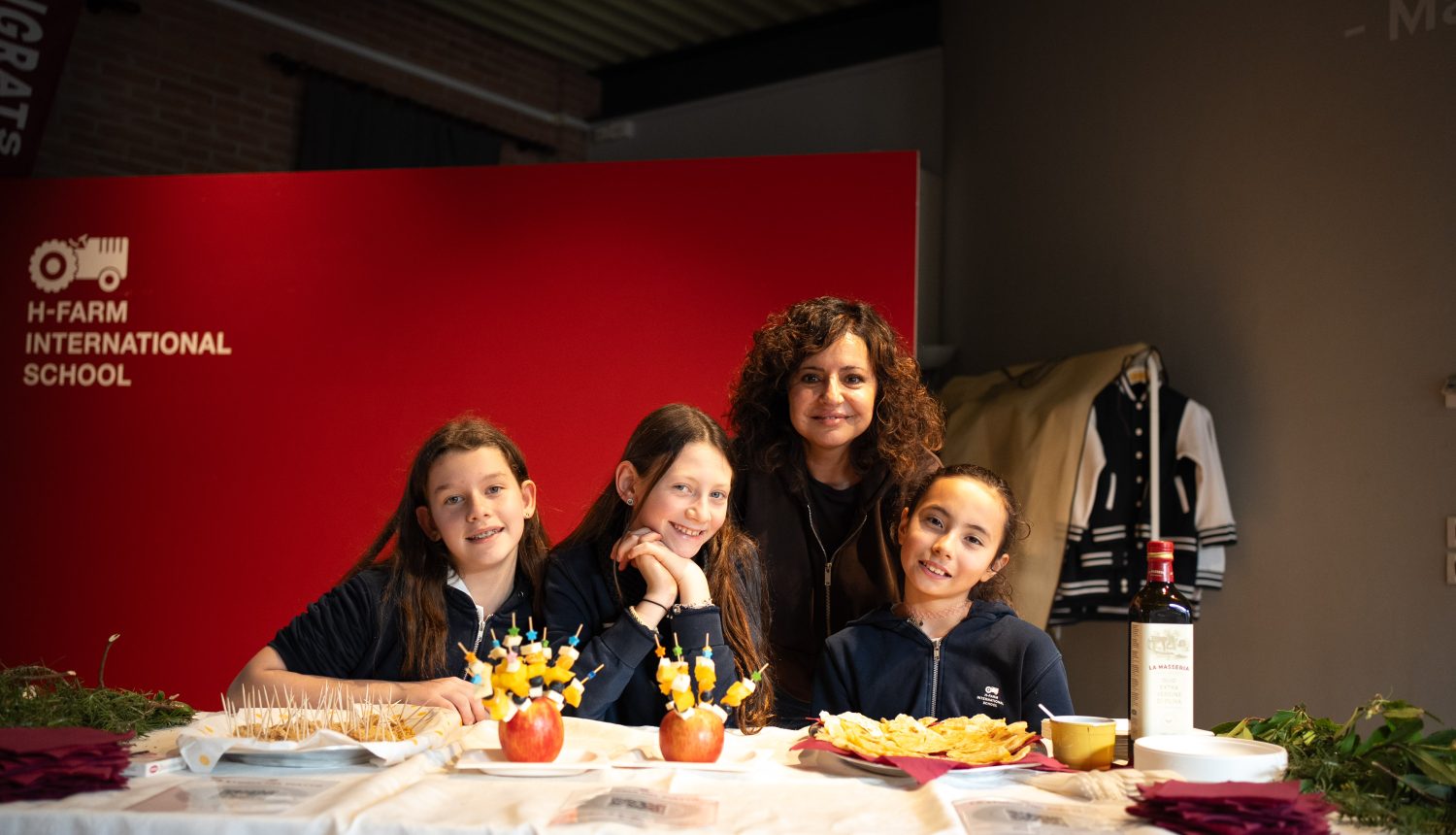
This was one of the moments of Digital Week “AI & ME”, the week during which classes at H-FARM International School Rosà opened their doors to families to show how artificial intelligence and digital technologies are becoming part of students’ learning journeys.
But above all, it was a moment when students became guides.
They were the ones explaining the projects, describing the different stages of the work, and involving parents in the activities—challenging them with the same tools and the same tasks they face in class.
As Ruggero, Visual Art Teacher and Digital Learning Coach at the school, explained:
“Artificial intelligence is not the future; it is the present. Students already encounter it every day: in automatic translators, voice assistants, and the algorithms that recommend content. Our role is to help them understand how it works.”
For this reason, at school AI is not treated as a separate subject. There is no dedicated “artificial intelligence” class.
Instead, it is approached through a cross-curricular pathway that runs across subjects, from art to technology, from science to digital citizenship, with a clear goal: to develop critical thinking, creativity, and awareness.
Imagining Better Cities
The sustainable city project is a good example of this approach.
Students began by observing real problems in contemporary cities: pollution, traffic, and energy consumption. From there, a simple question emerged: if we could design a better city, what would it look like?
The answer took shape in a collaborative scale model built with recycled materials and LEGO bricks. But students didn’t stop at designing urban spaces.
They also imagined robots capable of helping the city function better.

Using LEGO WeDo, students programmed small devices that move along predetermined paths and perform actions useful for the community—such as cleaning streets and fountains, generating wind energy, and even turning off all the city’s lights to reduce light pollution.
Coding thus became a tool for transforming an idea into something that actually works.

Understanding How AI Really Works
In Lower Secondary, the work went even deeper.
Students used Machine Learning for Kids and Scratch to train a system capable of recognizing voice commands and using them to control a video game.
One student described the process with a very concrete example. To teach the model to recognize the word “jump,” recording it once was not enough. It was necessary to provide many different examples: different voices, different tones, different distances from the microphone, even noisy environments.
Only in this way could the system learn to recognize the command even in more complex situations.
The experiment made a fundamental principle clear: artificial intelligence does not understand words like a human does. It recognizes patterns in the data it receives. The more examples provided during training, the more accurate the system becomes.
The video game also had another important dimension. Students imagined it as a tool that could potentially support inclusion: a voice-controlled game could allow people with motor difficulties to participate in the experience as well.
AI as a Training Ground for Thinking
In another class, artificial intelligence was used to develop a different skill: argumentation.
Students prepared an English debate using an AI tutor that helped them explore different perspectives on complex questions. Among the topics discussed were issues very close to their everyday experience:
- Is artificial intelligence an opportunity or a risk for teenagers?
- Should teenagers take regular breaks from technology?
- Are too many expectations placed on students at school?

The system did not provide ready-made answers. Instead, it proposed questions and counterarguments, pushing students to build and defend their own positions.
The result highlighted an important distinction: AI can be used either to do the work for us or to train the way we think.

When AI Becomes a Creative Assistant
In another workshop, artificial intelligence entered a completely different context: design and entrepreneurship.
The brief was simple: imagine launching a new cookie company.
Students designed the brand identity by creating logos and slogans with Adobe Illustrator. To find names and ideas for the advertising campaign, they used AI as a support tool, generating suggestions and variations to start from.
The ideas generated were not accepted automatically. Students compared them, improved them, and selected the most effective ones.
To present the product, they also created a commercial, and finally turned the digital logo into a real object by printing the brand’s official T-shirt.
Human in the Loop
Across all these activities, a key idea emerged, one that guides the school’s approach.
As Ruggero explained:
“For us, the principle is human in the loop. The human is always there: at the beginning, when something is imagined, and at the end, when the result is evaluated.”
Artificial intelligence can generate images, texts, music, or suggestions. But the real value of the process lies in the choices made by the person using it.
This is why students also learn essential skills: searching for information critically, recognizing reliable content, respecting privacy and intellectual property, and understanding that AI can be useful but is not infallible.
A Week That Opened a Dialogue
At the end of the week, what stood out most was not only the variety of projects, but the energy with which students presented them.
Many of them confidently explained tools and processes, guiding parents through the activities and inviting them to try robots, applications, and digital projects.
“The variety of the projects created by the students and the way they explained everything to us was impressive,” one parent said proudly.
For families, it was an opportunity to see up close what it really means to educate for artificial intelligence. For students, it was a moment to share what they had learned.
AI & ME was not just a week of technological activities. It was an opportunity to open a dialogue between school and families about one of the most important transformations of our time.
Because teaching artificial intelligence does not simply mean teaching students how to use a machine. It means helping them understand the world they are growing up in and how to take part in it with awareness.




 Back
Back

