Library Talks: Jesse McCreed
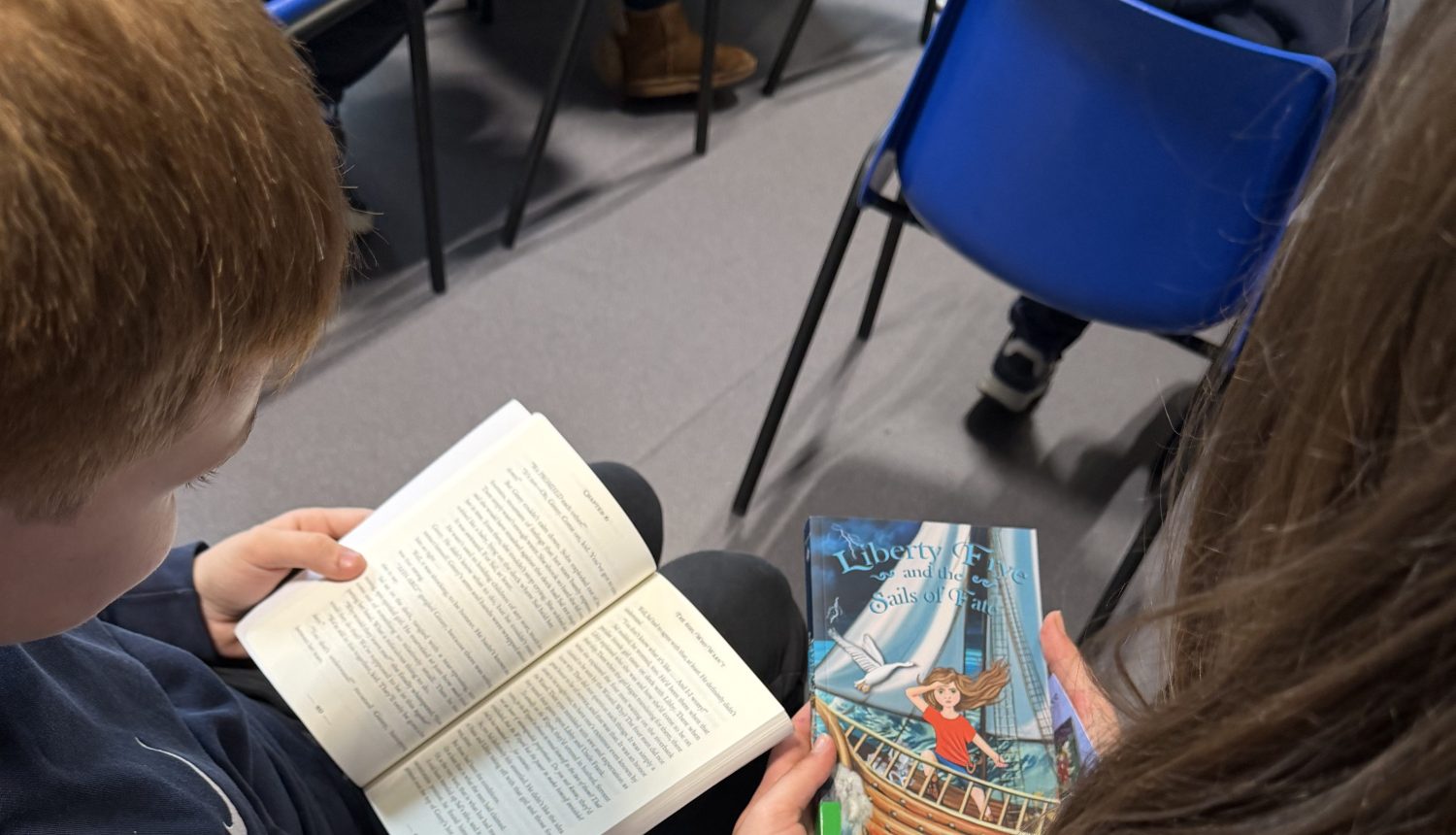
Exploring inspiration, creativity and the power of storytelling with the author of the Liberty Frye series
There are school days that feel a little magical, and yesterday was one of them. Our M1 and M2 students had the chance to meet Jesse McCreedy, author of the Liberty Frye fantasy series and a storyteller with a gift for turning curiosity into adventure.
She shared how she first became a writer, how traditional fables and fairytales can still enhance our creativity, the sparks of inspiration behind her characters and the thrill (and challenge) of creating new worlds from scratch. What resonated most was her message that stories often begin as a tiny idea, something small and bright that grows when we give it attention. Together, she and the students explored how to nurture that spark until it becomes a written story and eventually a full novel.
The room came fully alive when Jesse read excerpts from her Liberty Frye books. Students listened so intently that the session went beyond schedule because they simply did not want her to stop! For an author, there is no greater compliment; for our students, no clearer sign that stories truly hold power.
Jesse’s approach to fantasy is deeply connected to the themes of courage, identity and resilience that young readers face in real life. She spoke about her passion for creating characters who discover their strength in unexpected ways, especially at an age when the world feels wide open and uncertain.
Her visit left the students inspired and eager to ask their own questions, leading to a thoughtful conversation that touched on creativity, daily writing habits and the books that shaped her childhood.
Below is the interview we shared with Jesse, reflecting the curiosity of our students and the wisdom she generously offered in return.
1) Your stories follow teenagers who discover their strength while navigating extraordinary worlds. What inspired you to write about this moment of life, when everything feels possible and uncertain at the same time?
I think I have been drawn to writing about the preteen and teen years because that is when life takes a big shift. At least when I was young, everyone was keen to tell you how your hormones and your body would change, but for me, that wasn’t the biggest shift. The biggest shift was in my mind. It was how the simplicity of childhood and the (very often) one-dimensional explanations one receives for various aspects of life no longer fit.
It happens at different times for each of us, but I remember being around ten years of age, and feeling completely bewildered by the actions of others, and the incongruity between espoused values and actions. This observation opened a door for me, so to speak, where I grew increasingly curious about what was actually real, what matters, what is honest. And also, how does one face challenges and remain kind and strong and intelligent without becoming trampled or, alternatively, a bully?
As teen years went on, these questions grew increasingly important to me. I didn’t really realize it at the time, but it was through reading that my quest for these answers was not just permitted, but encouraged. In stories, you understand the unique plight of the characters, of the challenges they face, and of the repercussions that follow from their choices. At least in my experience, I never really had that kind of honest clarity when speaking to human beings in real time. Only in books do you gain that kind of insight. Books provide this magic key, not just to other worlds, but to the moral and psychological permutations in those worlds.
2) Fantasy often mirrors the challenges we face in the real world. What message of courage or resilience do you hope young readers take with them after meeting your characters?
I love this question! It hits one of my favorite aspects of my main character, Libby, in the Liberty Frye trilogy. I really wanted Libby to be this girl who never quite fits in, yet she’s mostly okay with that. That quiet self-acceptance is likely attributed to her loving parents and her eccentric great uncle. But then she’s yanked out of that world, and thrust, all alone, into a foreign and very scary environment. She has no idea how to cope, who to trust, what to do. She definitely does not feel confident. And that, to me, was the key. I grow frustrated by some characters in books or movies who overcome obstacles due largely to their confidence or swagger. I mean, those are fun stories to read, but what if you aren’t confident? And to that extent, what exactly is confidence anyway? In either case, in those kinds of stories, if you don’t have confidence or at least the ability to “fake it until you make it,” then our cultural message is that you will fail … and not just fail, but it’s a bit of a shaming on your own self. It’s your fault … because you lacked confidence. I think that’s a terrible message for anyone, but especially for evolving minds.
I wanted Libby to be scared and feel completely unconfident (as she rightly should considering her circumstance!), yet she pushes forward anyway. She keeps trying. She uses her intelligence to do the best she can under the circumstances. That, to me, is true courage. And my hope is that when kids read my books, they’ll absorb that message. Because it doesn’t matter so much how scared you are or how overwhelmed you are. You don’t have to feel like you have the answers. You just have to make the best choice you can, and move toward what you believe is a better solution. One step at a time. And if you fail, then get back up and keep trying.
3) If one of our students wanted to start writing fantasy today, what simple daily habit would you recommend to help them build imagination and confidence?
Fun question. For imagination, one of my favorite exercises is to look around, and pick something right in front of you that is totally boring and unexceptional. Let’s say it’s a pencil. But what if that pencil holds magical powers? What would they be? Or if you wrote with that pencil, would the words you write down actually come to life? Or would they imbue you with certain powers that you wouldn’t otherwise have? Or would the pencil actually be a magical staff from the Kingdom of Palandius (I don’t know; I just made that up!) that has been lost for a thousand years, and now, a fleet of faeries from this Kingdom have landed on earth in search of it? And what happens next?
You get the idea! What’s the extraordinary story lurking behind that unexceptional object? The more you ask this question and start writing down ideas, the easier it gets to come up with them and to develop new worlds.
Confidence: As my previous answer might have suggested, I struggle with what we perceive as “confidence.” For purposes of this answer, I think confidence is simply the belief that your pursuits and interests are worthwhile, and that you have something unique to offer. Well, each of us has our own unique, beautiful mind, within which each of us contain worlds and stories that only we can explore and express. If a child can be encouraged to understand the value of their unique thoughts and to pursue expressing them, I think this builds confidence. Also, one thing I’ve noticed through my various school visits is that children default to a sense of inability or failure if they don’t excel at something right away or at least find the endeavor easy. This is a huge concept for kids to grasp: Just because it is hard for you doesn’t mean you can’t be good at. Just because your friend can draw that picture with her eyes closed while you struggle to draw a straight line doesn’t mean you are destined to be a poor artist. Just keep trying. Don’t give up. Just do a little bit of work towards your goal every day, and you’ll get better. And in a way, your struggle and the difficulties you face make your story or artwork or whatever it is that you might be working on that much more nuanced and interesting. This theme of persistence and self-belief is also the main message in my rhyming picture book, Theodore, The Sloth Who Wants to Race.
4) Stories often become companions as we grow up. Was there a book or character that shaped you when you were their age?
I remember speaking about this with the kids at my most recent visit at H-Farm. The Chronicles of Narnia was huge for me. Those magical, hidden worlds, just coexisting right in front of us! And A Wrinkle in Time. Perhaps because I grew up in boarding school, I remember loving The Little Princess and The Secret Garden as well.
5) What do you hope students feel, imagine, or question after spending time in the worlds you create?
I hope the message that we’ve touched on in this interview seeps into their sense of ability. Specifically, I hope kids see that, even if they feel that they can’t do something, that feeling has no bearing on their actual ability. If they want to be good at something, then they have to keep trying. Don’t give up. And don’t compare yourself to what others are doing. March to the beat of your own drum and keep applying yourself.





 Back
Back

