Rethinking the Ocean: Valentina Lovat on Science, Myths, and Our Connection to the Planet
How many oceans are there in the world?
If you thought “five,” you’re not wrong, but that’s not the whole story.
We tend to picture the world as a neatly ordered mosaic: five oceans, each with its own name, separated by imaginary lines on a map. Atlantic, Pacific, Indian, Arctic, Southern. That’s how we learn them in school, as if they were distinct, self-contained bodies of water.
But a closer look at a world map is enough to reveal that these divisions exist only on paper. There is no physical boundary separating one body of water from another. In reality, Earth has a single ocean: a vast, living system made up of five interconnected basins that constantly exchange energy and influence one another.
We tend to picture the world as a neatly ordered mosaic: five oceans, each with its own name, separated by imaginary lines on a map. Atlantic, Pacific, Indian, Arctic, Southern. That’s how we learn them in school, as if they were distinct, self-contained bodies of water.
But a closer look at a world map is enough to reveal that these divisions exist only on paper. There is no physical boundary separating one body of water from another. In reality, Earth has a single ocean: a vast, living system made up of five interconnected basins that constantly exchange energy and influence one another.
Connecting Ocean Science and Society
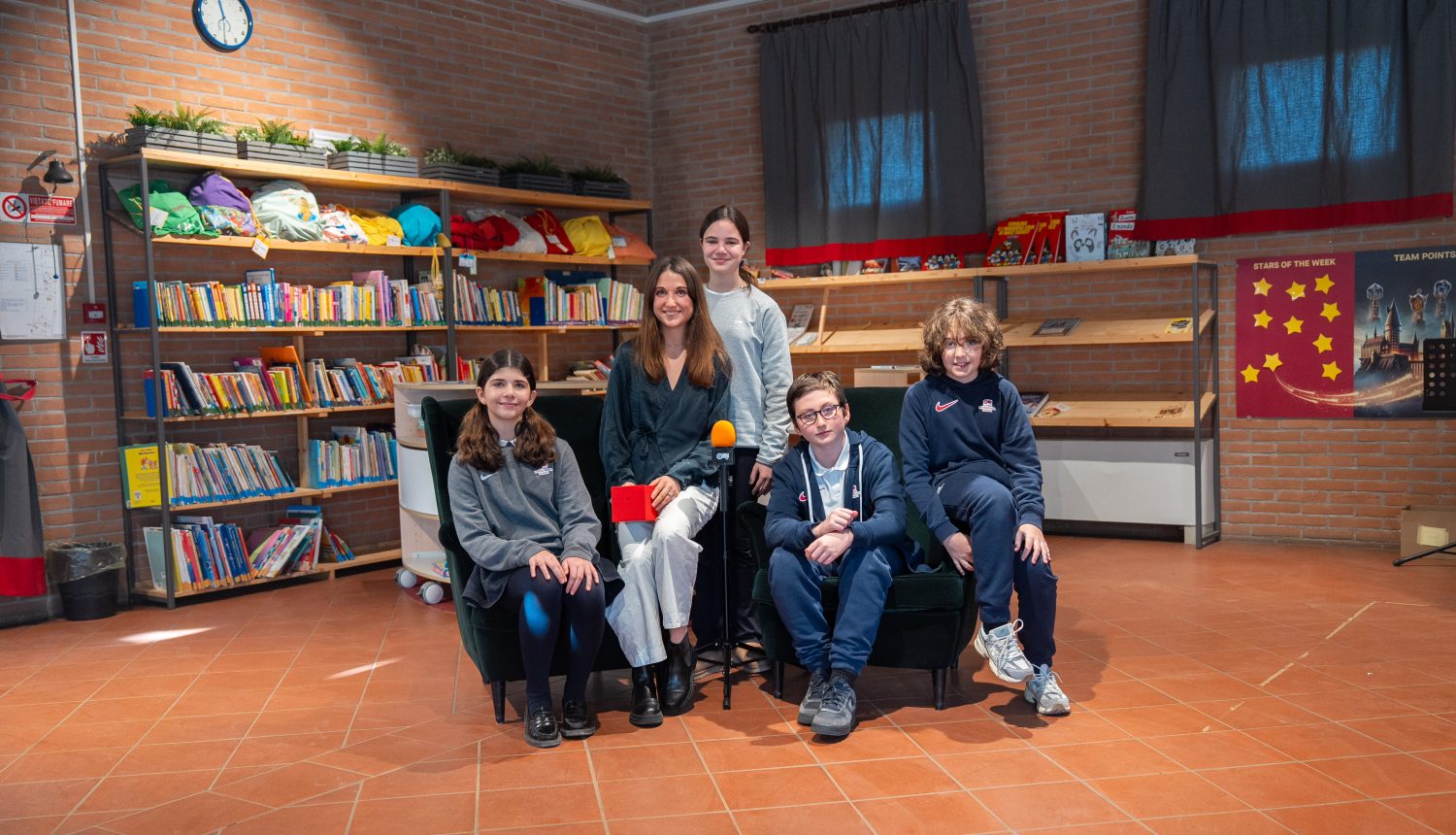
This was just one of the many insights that captured the attention of our students in Rosà during a special meeting with Valentina Lovat, marine biologist and oceanographer, with professional experience in international contexts such as UNESCO, where she worked on ocean-related and conservation projects. Today, she works as a project manager and science communicator, translating scientific knowledge into new forms of social awareness.
Her work sits at the intersection of science and society, guided by a clear purpose: helping people build a more informed and conscious relationship with the ocean because only what we truly understand can we learn to protect.
Valentina shared her personal and professional journey, which began in childhood through a natural and lasting connection with water. Today, she brings that passion into educational and cultural settings, driven by the belief that progress often begins by questioning what we think we already know and opening ourselves to new perspectives.
From this starting point, her presentation encouraged students to reflect on aspects of the ocean that are often taken for granted.
What Lies Beneath the Ocean’s Surface?
We are used to imagining a flat, uniform seabed. Yet shifting perspective reveals a geologically complex landscape, one that is hard to even picture, made of mountain ranges stretching across entire ocean basins, deep canyons, underwater volcanoes, and abyssal plains that can reach depths of up to 11,000 meters, such as the Mariana Trench.
It is a vast and intricate world, invisible to our eyes yet fundamental to the balance of life on Earth.
Another common misconception Valentina addressed concerns coral reefs. Many people think of corals as plants or colorful algae. In fact, they are animals: tiny organisms capable of building massive limestone structures that become true biological architectures supporting marine biodiversity. Over centuries, coral reefs develop into complex, densely populated, three-dimensional environments. For this reason, Valentina describes them as “the metropolises of the sea”: layered ecosystems, like skyscrapers, teeming with life at every level.
Ultimately, the ocean is far more than what we see on the surface. It covers 71% of the Earth’s surface and hosts over 90% of the planet’s habitable space. It is as much our home as the land, perhaps even more so.
And when we consider that the water reaching our shores today may have traveled thousands of kilometers, taking up to a thousand years to complete a global journey through thermohaline circulation, it becomes clear just how deeply everything is connected within this millennia-long loop.
Understanding this connection makes it almost inevitable to feel part of something larger and more fragile than what is visible at first glance.
Learning to See the Planet with New Eyes
The meeting with Valentina was not simply an in-depth lesson in marine biology. It was an opportunity to reflect on our role in the world. You don’t need to be a scientist to contribute to sustainability.
You can work in any field, from technology to finance, from creativity to space exploration, carrying with you values of care, responsibility, and respect. More than any specific career path, these values are what make it possible to build a future in which people understand the deep relationship that connects them to the planet.
And if the ocean is one, then so are we: a single community sharing resources, responsibilities, and a common future.
Understanding this is the first step.
The second is acting with awareness.





 Back
Back

