Understanding the Human Body Beyond the Textbook: an Immersive Experience between Science and Digital Design
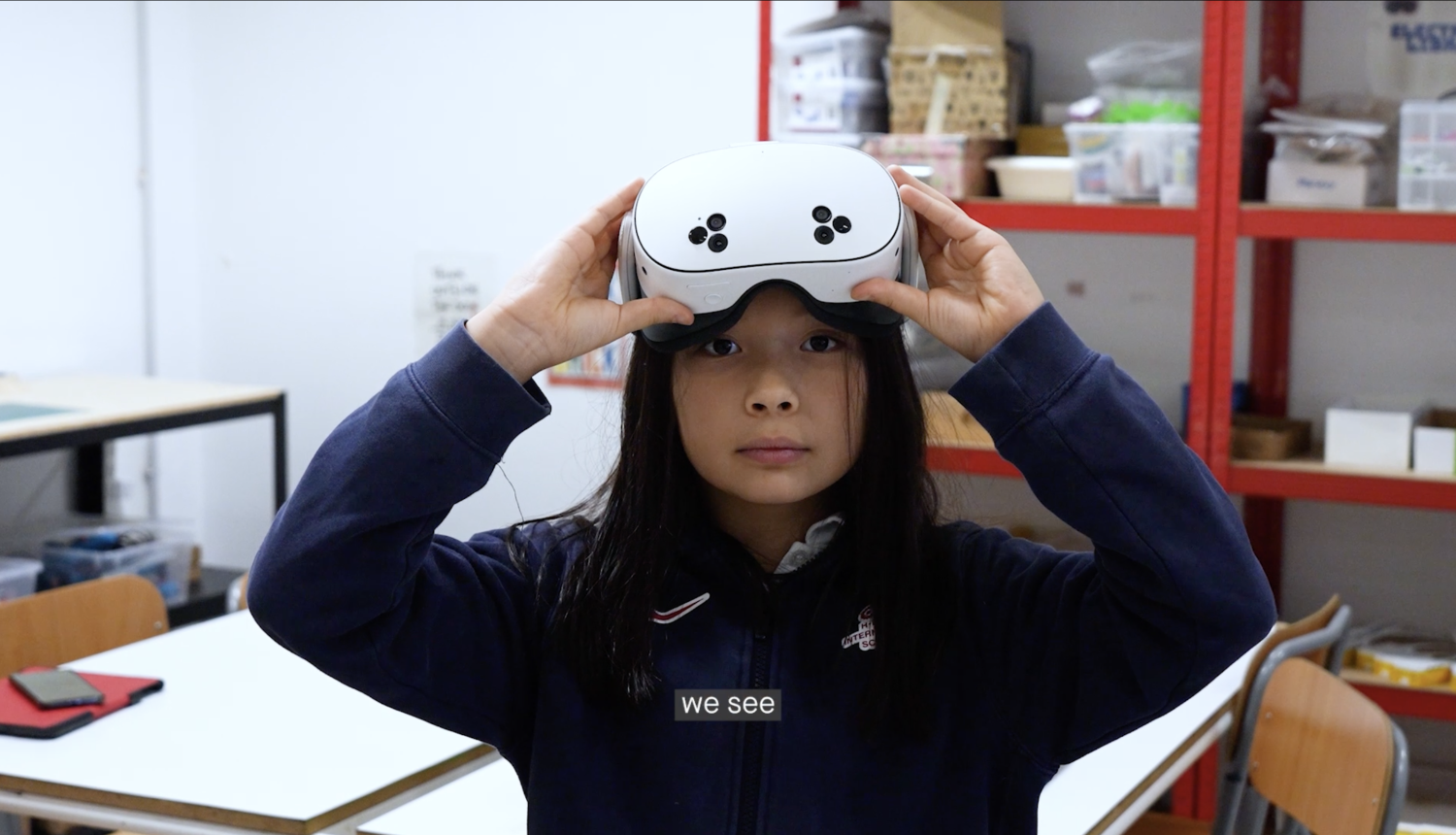
Have you ever stepped inside a human heart?
This is not a rhetorical question, nor a narrative device. It is a concrete possibility, even if a rare one, especially in a school setting. An experience that usually belongs to the realm of imagination, high-level scientific communication, or advanced university education, and that, in this case, became an integral part of a regular learning activity designed for our PYP5 students of Vicenza Campus.
Not just to amaze.
But to understand better.
When the textbook is no longer enough
Studying the human body has always been a complex challenge. Organs, systems, and vital functions require a high level of abstraction, especially when they are presented through static images, two-dimensional diagrams, or simplified sections. Useful tools, but often insufficient to convey the true complexity of a living, three-dimensional, and deeply interconnected system.
For this reason, Mr. Davide Gusatto, Digital Design teacher, and Miss Francesca Rigon, Science teacher, designed a learning pathway that brought these two subjects together, taking the study of anatomy out of the textbook and directly into the classroom space.
A life-size human body in real space
Thanks to the use of an augmented reality headset (META Quest3S), students were able to visualize a life-size human body not in a separate virtual world, but in the same physical space where everyday learning takes place.
The anatomical model is fully explorable, and each component is accompanied by information cards describing its name, function, properties, and location within the human body. This allowed students to explore organs, systems, bones, and muscles; understand their position and composition; virtually deconstruct the body to analyze its parts; and “touch with their hands,” albeit digitally, what usually remains abstract.
This real “body parts hunt” turned the study of anatomy into an active research activity, in which students had to identify specific organs, observe them, describe them, and connect them to the knowledge learned in class.
Exploring the human body from the inside
One of the most interesting and surprising aspects of this technology was the possibility to literally enter inside anatomical structures: moving through a thorax, observing the heart from the inside, or looking through the pupil of an eyeball.
An experience like this inevitably sparks curiosity and engagement, as shown by some spontaneous student comments such as:
“Wait a second, I’m full of veins!”,
“Where do I put the clavicle?”,
“How do you get inside the heart?”,
“Where do I put the sternum I detached?”,
“Miss, I put my head in the thorax!”.
A new relationship with technology
For many students, this was their first real encounter with immersive technology used not for home entertainment, but for learning. Augmented reality showed them that technology is not only about entertainment or escape, but a powerful tool to better understand the world around us and ourselves.
 WATCH THE VIDEO
In this context, technology becomes a means to explore and understand, a bridge between theory and reality. Not parallel worlds or fictional objects, but digital content integrated into real life, making learning more meaningful and conscious.
Differentiated learning and pedagogical value
From an educational perspective, an activity like this responds concretely to a fundamental principle: not all students learn in the same way. Some need to observe, others to manipulate, others to move through space to build solid understanding.
Augmented reality makes it possible to integrate these approaches, transforming study into an active experience where curiosity becomes the starting point for learning. Theory immediately connects with practice, supporting a deeper and more lasting understanding of scientific content.
Technology and the IB curriculum
Within the International Baccalaureate framework, experiences like this fit naturally into the curriculum. The conscious use of technology strengthens conceptual and transdisciplinary learning, offering students tools to observe, research, and reflect critically.
Technology is not the focus of the experience, but the means that allows students to become active participants in their own learning journey. In this way, the IB approach is reinforced, aiming to develop curious, aware students capable of understanding the complexity of the world around them.
An experience that also looks to the future
Similar technologies are already widely used in the most advanced healthcare contexts, from university-level medical education to the simulation of complex procedures. Bringing them into school, adapted to students’ age, means connecting education with real, concrete, and current practices.
Above all, it offers students a different perspective: learning is not about accumulating information, but about building solid mental models to interpret reality.
When teaching truly works
The students’ final feedback was direct and unmistakable:
“It was the best lesson of my life.”
An emblematic sentence that tells of an experience where curiosity, rigor, and engagement found a rare balance. A concrete example of how educational innovation does not necessarily come from adding content, but from changing perspective.Sometimes, to truly understand the human body, you need to stop looking at it from the outside.
And finally start stepping inside.



 Back
Back

