
We spend a large part of our days at work.
Sitting at our desks, under fluorescent lights, immersed (at least for some of us) in environments that are more or less crowded and noisy.
And yet, we rarely stop to think about how much that space truly affects us.
How it shapes how we feel, how well we’re able to concentrate, how we think and work together.
Space Is Not Neutral
Today we know that space is not neutral: it can enable or hinder, stimulate or drain, connect or isolate.
And so the question becomes inevitable: how do you design a workplace that truly works for people?
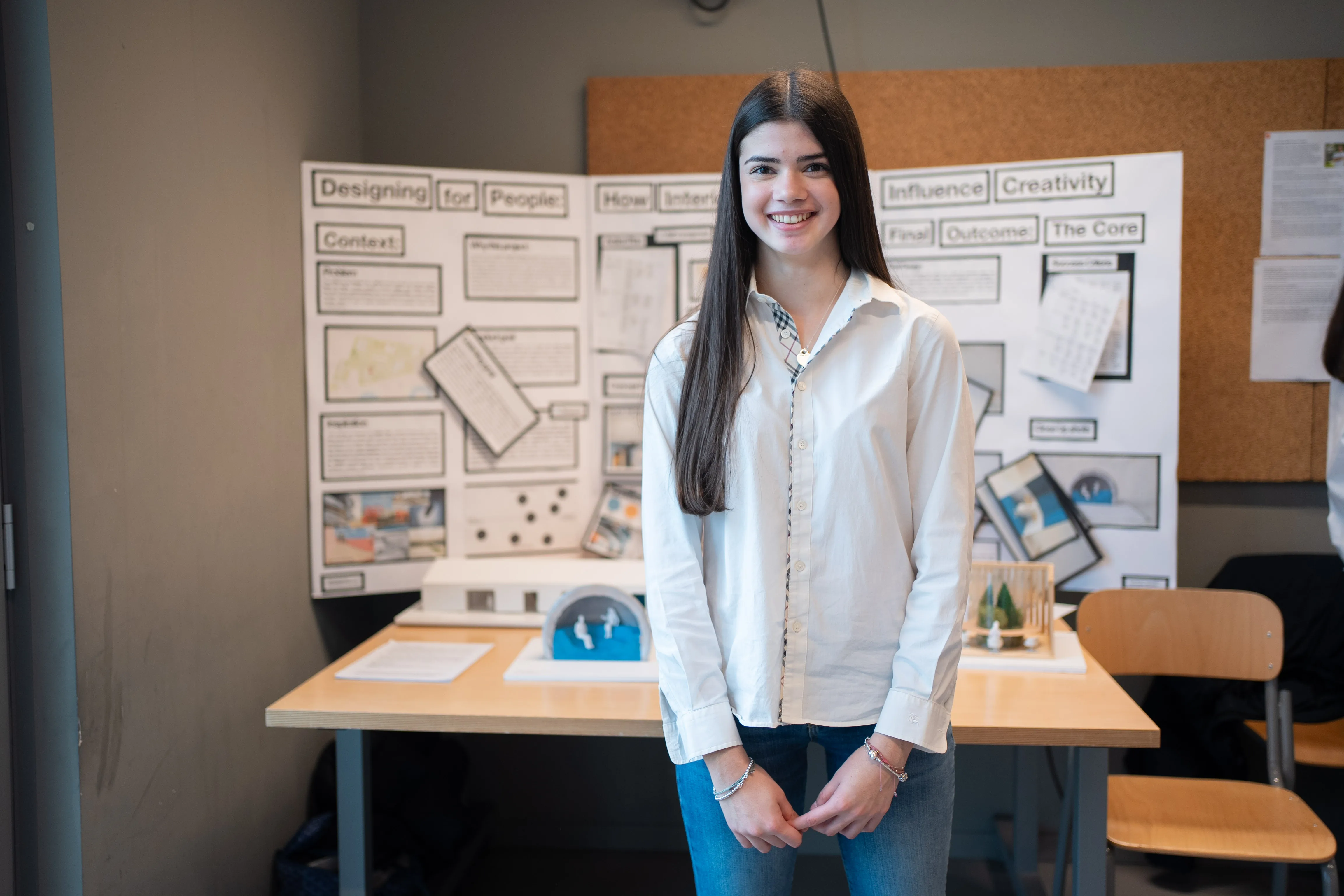
It is from this question that Francesca’s research began. For her Personal Project, she chose to redesign her parents’ office: a real, lived-in space, used every day, with established habits, critical issues, and often unspoken needs.
To truly understand what worked and what didn’t, Francesca listened to the people who inhabit it. She interviewed her parents’ colleagues, gathered direct observations, and paid attention to small, everyday details that, when brought together, reveal far more than any ideal model ever could.
Noise, difficulty concentrating, inadequate lighting, spaces that fail to adapt to different ways of working, elements that, taken individually, may seem marginal, but over time come to define the quality of the experience for those who use them.


From Problems to Possibilities
This is where the project begins to take shape.
Francesca envisions a space that doesn’t simply “function,” but supports work, facilitates it, and makes it more sustainable.
An environment where design, architecture, and a focus on well-being intertwine, transforming the office into a place that adapts to people, not the other way around.
To achieve this, she studied how ergonomics, acoustics, natural and artificial light, color psychology, and the organization of movement flows can influence human behavior, improving concentration, productivity, and well-being.
Drawing inspiration from places like Apple Park and installations such as Anish Kapoor’s Cloud Gate, she develops a system of fluid environments designed to respond to different needs: focus, collaboration, and rest.

A New Ecology of Workspaces
Distinct yet interconnected spaces begin to emerge.
Individual workstations are reimagined as more enclosed settings, designed to reduce external interference without completely isolating people from the work context. Through more protected configurations and greater attention to acoustics, they become an evolution of the open-plan office, capable of balancing concentration and connection.
Collaborative areas, on the other hand, open up and reorganize around central elements, such as “The Grass is Greener”: a space where light and nature are not simply decorative features, but true design tools.
Here, lighting becomes dynamic, adapting to the rhythm of the day, while the presence of plants and natural materials helps create a more balanced and restorative atmosphere.
This is not just about aesthetics, it is a way of directly influencing energy, attention, and how people experience the space.
Alongside these environments, a more flexible and hybrid dimension takes shape: “The Infinite Loop,” designed for informal collaboration.
A modular, reconfigurable space where movable elements, continuous surfaces, and curved forms allow it to adapt to different situations, from spontaneous interactions to group work.
Here too, nothing is accidental: colors, geometries, and materials follow principles of harmony and balance, helping make the space more intuitive and less rigid.
Completing the system is a more radical element: “Enjoy the Silence,” a space designed to fully isolate from noise and restore a dimension of deep concentration.
No longer an adaptation of the existing environment, but a true alternative, where silence itself becomes a design resource.
All these spaces are part of a broader vision, which Francesca defines as a form of “eco-architectural harmony”: a balance between architecture, nature, and well-being, inspired by models like Apple Park, where light, materials, and spatial organization work together to create more human and sustainable environments.


Each space, therefore, is not just a functional solution, but part of a coherent system in which the transition from one environment to another is fluid and natural.
To translate this vision into something concrete, Francesca developed a digital layout in CAD using Shapr3D, defining in detail spaces, proportions, and relationships between environments. She then created a physical model, turning ideas and sketches into something tangible and real.
But what makes this project particularly meaningful is not only the final result.
It is its deeper significance.
Because rethinking an office does not simply mean rearranging furniture or improving the aesthetics of a space. It means questioning how we want to work, what kind of environments we want to inhabit every day, and what kind of relationship we want to build between people and places.
And perhaps that is the point.
If we spend a large part of our days at work, then designing those spaces is not just a functional matter. It is a responsibility.


 Back
Back

