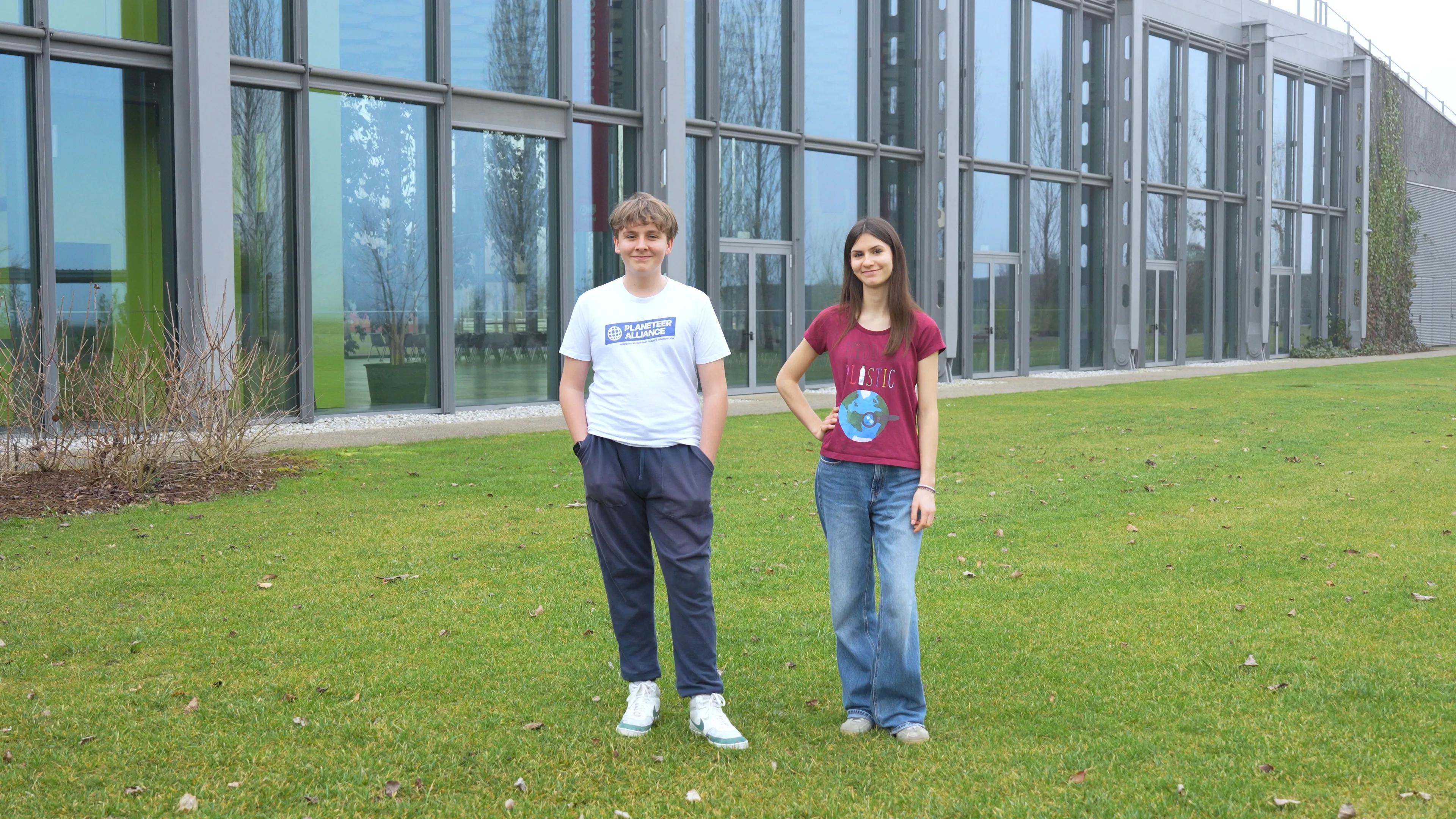

Have you ever stopped to think about what really happens to the plastic we use every day?
For Zara and Ashton, that question arrived early and never really left. Growing up close to nature meant learning to love the ocean, but also becoming aware, step by step, of how deeply human activity is harming it. That awareness came with a sense of concern, sometimes even anxiety, and with the feeling that something had to be done.
Zara is now 16, Ashton 15, but Hidden Plastic, the environmental organisation they co‑founded, started five years ago, when they were just 11 and 9. What began as a small, intuitive response to climate anxiety has since grown into a recognised youth-led advocacy project, capable of bringing the voices of under‑18s into some of the most important international negotiations on plastic pollution.
From concern to action
Like many young people, Zara and Ashton felt overwhelmed by the scale of the plastic pollution crisis, so during the lockdown, they took part in the Ocean Heroes Virtual Bootcamp organised by the Planeteer Alliance. An experience that permitted them to encounter other young activists already engaged in environmental action.
“For the first time ever we saw that you don’t need to wait until you’re a grown‑up to make a difference,” Zara explains. “There’s a power in being a young person in this space right now.”
 WATCH THE VIDEO
After the bootcamp, they began experimenting with what they knew best: creativity, storytelling and a little bit of video-making.
Their first short educational videos about plastic pollution were born from this phase, aiming to explain what often goes unseen: microplastics in the food we eat, the air we breathe, our blood, and especially our oceans in an accessible way for everybody.
Hidden Plastic didn’t begin with a grand plan. It grew gradually, through experimentation, learning and consistency. “We never started out thinking we’d create a big organisation,” they explain. “We started by making a few videos, and then one opportunity led to another and before we knew it we were at the Global Plastics Treaty.”


As the project evolved, so did their understanding of impact.
Zara and Ashton soon recognised that raising awareness is essential, but real change often happens elsewhere. “You can’t convince every single person on the planet,” Ashton says. “But you can try to reach the people who actually have the power to change the rules.”This realization brought them into the heart of international political processes.
Starting in 2022, with the launch of negotiations for the Global Plastics Treaty, Hidden Plastic entered an entirely new dimension. Over time, the two siblings participated in four of the six Intergovernmental Negotiating Committee (INC) sessions on Plastic Pollution: INC-2 in Paris (2023), INC-4 in Ottawa (2024), INC-5 in Busan (2024), INC-5.2 in Geneva (2025), becoming among the youngest delegates ever present (at the time Ashton was the only 12 years old present in the negotiations). An extraordinary achievement, given the technical and political complexity of these meetings.

They also took part in high-profile advocacy moments, including speaking together at the Captain Planet Foundation Annual Gala in 2024. Addressing an audience of around 500 people, it was their first major public speaking experience as a duo, made even more memorable by the presence of figures such as filmmaker Francis Ford Coppola and representatives of major international foundations.
Their participation was far from symbolic. Zara and Ashton worked actively with the UNEP Children and Youth Major Group, bringing under-18 perspectives into spaces where, until recently, young people were simply not represented.
Ashton, MYP Student
“We realised there were very few people under 18 in those rooms and that made it even more important for us to be there.”


Learning paths
Alongside their advocacy work, both Zara and Ashton have continued to grow academically with us at H-FARM International School, where their projects and experiences outside the classroom have been an integral part of their learning journey.
For Ashton, Hidden Plastic has always been closely connected to visual storytelling and the technical side of communication. When he discovered he could explore filmmaking through his studies with us, he embraced the opportunity to develop those skills further.
For Zara instead, school played a key role in helping her refine both her interests and her future direction. “For as long as I can remember, I thought I wanted to be a marine biologist,” she says. “Science felt like the most direct way to make an impact.” During her studies with us, she explored this path deeply, taking an advanced science curriculum, before gradually realising that advocacy, policy and economics could be just as powerful tools for change. “Having a well-rounded programme helped me understand where I could make the biggest difference,” she reflects.
That awareness was further strengthened during a school trip to the Maldives where she had the opportunity to deepen her understanding of plastic pollution organizing a visit to the the Maldives Ocean Plastics Alliance (MOPA), one of the few non-governmental facilities in the country capable of collecting, compressing and exporting plastic waste for recycling.
Zara, DP Student
“Seeing with my own eyes what it means to tackle plastic pollution on the ground was fundamental, It helped me connect activism, policy and real solutions.”


Nairobi: inside the UN
The most recent chapter of Hidden Plastic, for now, unfolded in Nairobi, during the seventh United Nations Environment Assembly (UNEA-7), held in December 2025 at the UNEP headquarters. Over 6,000 delegates from more than 180 countries attended, with eleven new resolutions adopted on topics ranging from plastic pollution to artificial intelligence, coral reefs and wildfires.
Throughout the week, they attended plenary sessions, side events and high-level meetings, speaking in front of key figures such as Inger Andersen, Executive Director of UNEP, and sharing youth priorities with environment ministers from Japan, Kenya and the European Union.
“What gives us hope,” they explain, “is that at these events many negotiators are genuinely willing to listen to young people. That doesn’t mean the work is finished but it shows that change is possible.”When asked what it feels like to be present in such important contexts, their answer is immediate.
Zara, DP Student
“It’s a huge emotional experience. You don’t always realise how big it is while it’s happening. Then you take a step back and think: what just happened?”


“By now we’ve been attending these kinds of events for five years, and it’s still emotional,” they add. “But the fact that the project has grown slowly and organically has allowed us to face even very complex situations.”
Throughout the week, they followed plenary sessions, took part in contact groups on issues such as plastic pollution, coral reefs and invasive seaweed, and attended side events linked to the Global Plastics Treaty.
“You sit in rooms where the language is very technical, very political,” Zara explains. “But you’re there to listen, to understand, and to make sure youth perspectives are not left out.”
Growing together
At the heart of Hidden Plastic there is also a sibling relationship built on trust, shared values and constant dialogue. Working together has meant learning how to listen, disagree, support one another and grow side by side, both as activists and as individuals.
While Ashton focuses more on video-making and technical production, Zara leads on communication, policy and outreach. “We don’t step on each other’s toes,” Ashton says. “We have different strengths, and that makes working together easier.”
Zara, DP Student
“We’ve grown up with this project, and it’s grown with us.”


Today, Hidden Plastic is the result of years of persistence, curiosity and courage and proof that meaningful change doesn’t require waiting for permission.
Change begins with a shared concern, and the decision not to stand still.
Even and especially, when you’re very young.
Looking ahead, both Zara and Ashton are clear about what comes next. Being part of the Global Plastics Treaty process and continuing to contribute to it as it evolves, is not just a short-term goal, but something they hope to pursue in the long run. “If we can stay involved and help make sure the process leads to a strong and ambitious agreement, that would already be huge,” they say. For Zara in particular, this commitment feels deeply personal. “I’m absolutely willing to dedicate my career to this,” she explains.
Their message to other young people who care about the environment or any cause, is simple and grounded in experience: start small. “You don’t need to have everything figured out,” they say. “Just find something you enjoy and begin there.” In their case, it was filmmaking; for others it might be music, art, writing or communication. What matters is taking the first step.


 Back
Back

