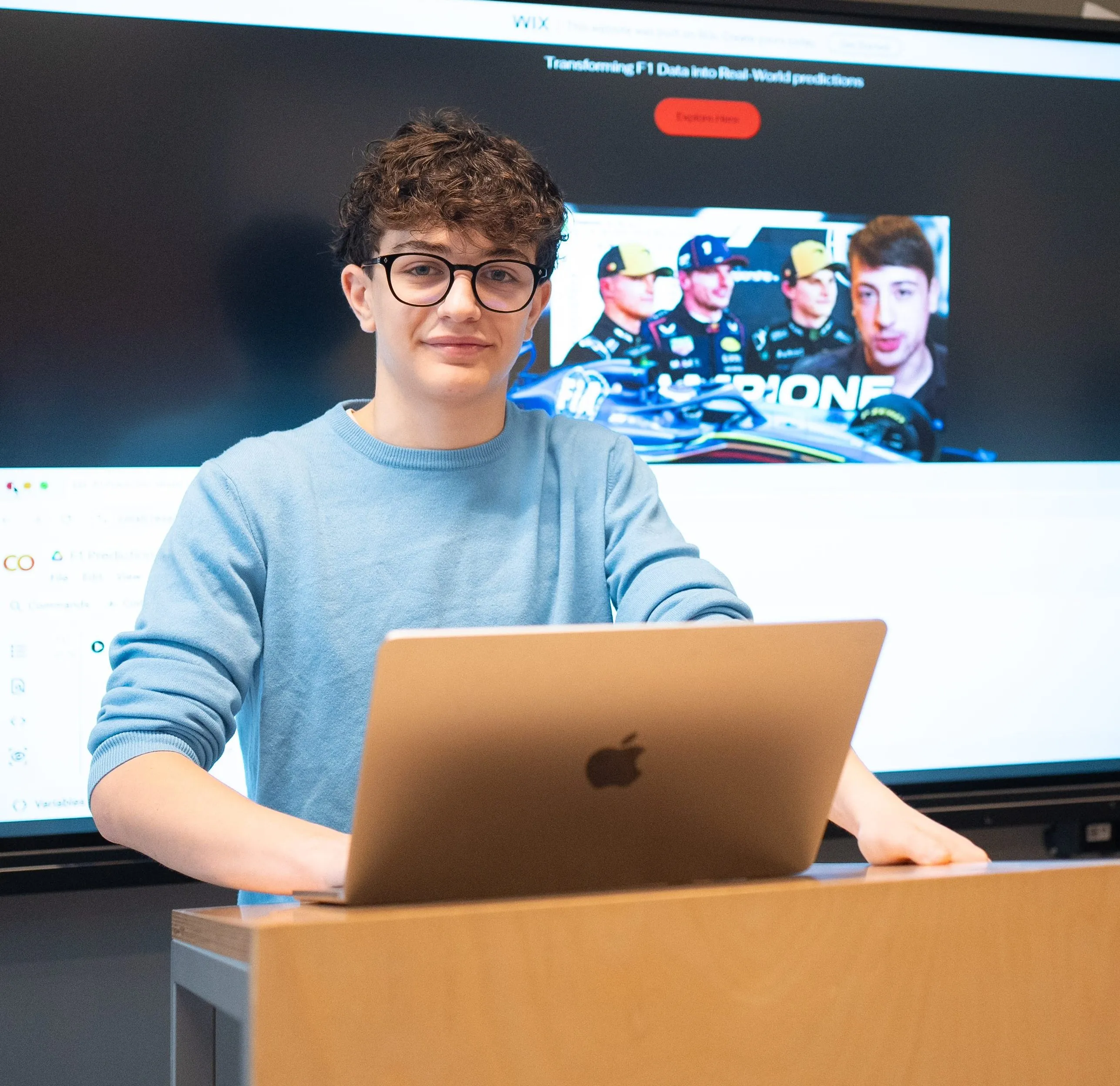

He was two years old when he watched his first Formula 1 race.
He didn’t like it. The cars were too fast, the noise too loud.
Thirteen years later, that same Formula 1 has not only become his greatest passion: it has become a professional goal.
“Every morning I wake up thinking that I want to become an F1 engineer,” he says.
What fascinates Lorenzo isn’t just the overtakes or the edge-of-the-limit strategies.
It’s what happens afterward. The numbers. The telemetry. The invisible correlations.
Lorenzo, MYP Student
“I like the parts people consider boring. The long datasets, the deep analysis. Understanding why something happened.”
It is precisely from this obsession with “why” that his Personal Project was born: RACENG F1 Predictor, an open-source machine learning tool designed to predict Formula 1 race results.
The platform is built on more than 3,000 processed CSV files, over 6,000 lap times collected between 2022 and 2025, 15 structured datasets, and variables including qualifying results, sprint races, tire degradation, race pace, and drivers’ historical performance. For each simulation, the model runs 5,000 iterations, identifies non-linear correlations, and outputs a probabilistic ranking.
In his family, predicting race results had become almost a ritual. Sometimes Lorenzo guessed right, sometimes he didn’t. But at a certain point, guessing was no longer enough. That’s when he began asking himself how to build a system capable of producing grounded analysis, not just intuition.
He started from scratch.
Through hours of independent study, technical tutorials, online courses, and statistical deep dives, he learned how to structure complex datasets, evaluate a model’s accuracy using metrics such as Mean Absolute Error, and implement a Random Forest Regression system. He chose this approach deliberately: powerful enough to capture complex relationships between variables, yet manageable for someone approaching machine learning for the first time.


Lorenzo then brought together his work, technical documentation, and model updates into a website, where he explains the methodology, the data used, and future developments. A space that is not just a showcase, but an open laboratory, designed to share the process as much as the outcome.
Confident in the robustness of his model, he decided to test it publicly. He contacted Alessandro Rastrelli, known online as “Il Rastro,” one of the most followed Italian content creators in the Formula 1 scene, proposing to test the system live on a real case: the Abu Dhabi Grand Prix.
It was no longer a private experiment. If the prediction had failed, it would have failed in front of everyone.
But it didn’t.
Trained on thousands of data points and configured to run 5,000 simulations per race, the model recorded an average error of just 1.2 positions compared to the actual result.
Yet the Abu Dhabi prediction was not the beginning of Lorenzo’s journey toward engineering in Formula 1. It was the final step in a path that had started years earlier.

Building Before Predicting
Long before RACENG, before machine learning and regression models, Lorenzo was already trying to understand performance from the inside.
The project he is most proud of dates back to middle school: building a wind tunnel to analyze, through the FlowViz technique, the interaction between airflow and the 2020 Ferrari single-seater. The goal was not to replicate a car, but to understand the aerodynamic principles governing downforce and drag.
“It was the project that made me realize that even a young student can enter the world of Formula 1 with complex projects, if he truly believes in it.”
More recently, he designed and built from scratch a fully functional 1:10 scale model of a 2016 single-seater, complete with an active DRS system. Every component was designed in 3D and later tested using CFD software on his own computer, to verify that the aerodynamic concepts studied in theory were reflected in the data.
Last summer, he further expanded this perspective by attending a two-week intensive engineering program at University College London (UCL). Mornings were dedicated to university lectures, afternoons to working sessions and design competitions.
He naturally gravitated toward civil engineering and dynamics challenges, winning both. But it was the aerodynamic competition that proved particularly meaningful. Students were required to design a wing profile capable of sustaining the highest possible angle of attack without stalling, a delicate balance between lift and flow stability.
His project achieved the best performance metrics in the group.
The prize was a meeting with a former Formula 1 engineer who had worked at Mercedes, contributing to the development of one of the most dominant cars of the modern era.
“It was probably one of the most important moments of my life as a student,” he recalls.


Learning Through Failure
What connects all these projects is not only technical ambition, but the method behind them: design, simulate, measure, refine.
Lorenzo often quotes a phrase by Niki Lauda: “You learn absolutely nothing from success. It is from failure and mistakes that conclusions can be drawn.” This mindset shaped his workflow: test, evaluate, adjust, repeat.
His experience with tennis also helped him greatly in this regard: “In a sport where the best players win only 53% of the points, you learn that losing is part of the process,” he says thoughtfully.
With his eyes set on his role models (Adrian Newey for engineering vision, Charles Leclerc for determination on track) Lorenzo envisions his future in Formula 1 not as a sudden achievement, but as a technical path to be built over time. First as an engineer within a team, then taking on increasing responsibilities, ultimately aspiring to the role of Chief Engineer.
We, who over the years have witnessed firsthand his commitment, curiosity, and determination, know that this is not just a dream spoken out loud.
It is a goal built day after day.
And we are certain that Lorenzo will find a way to achieve it.


 Back
Back

