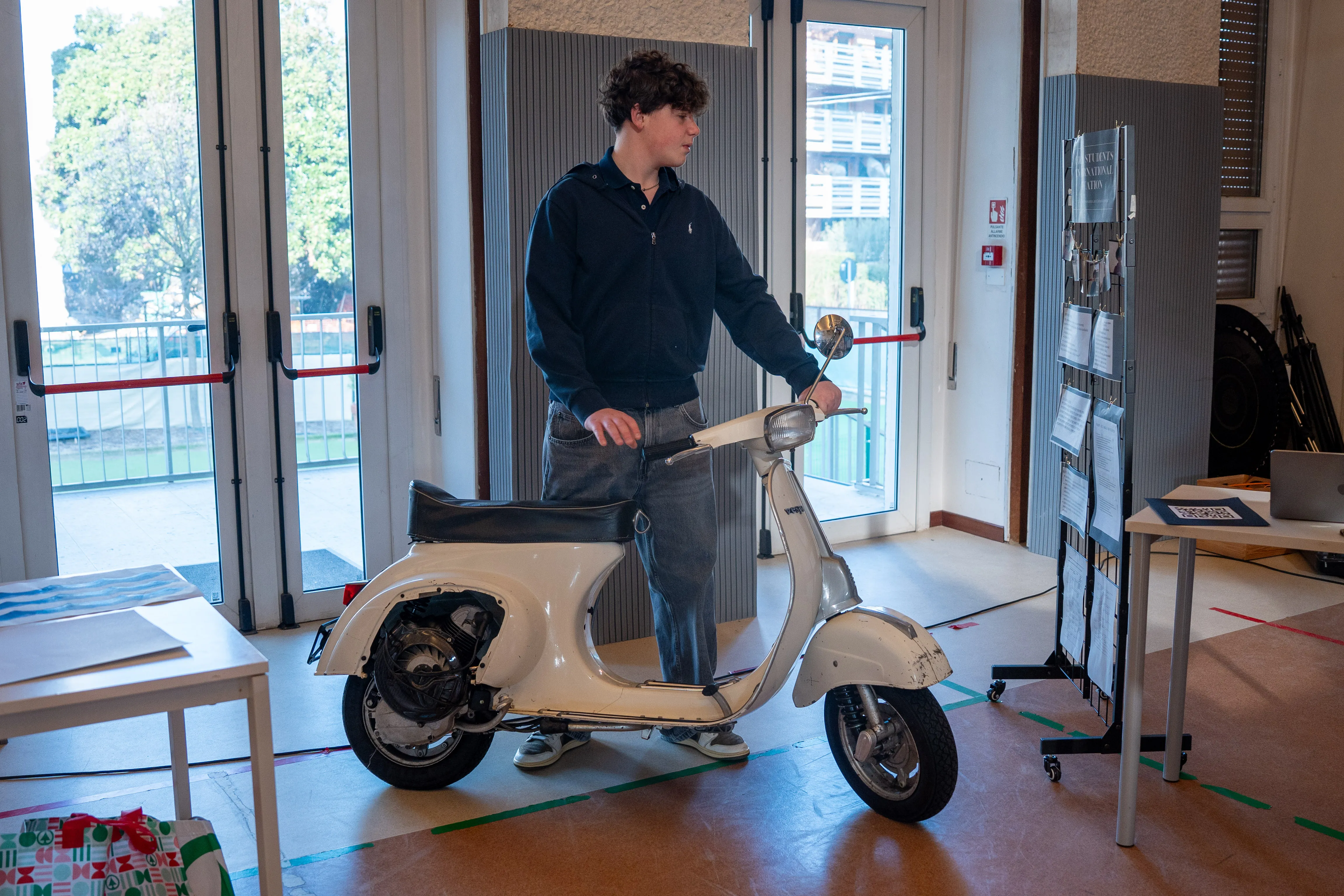

Is there a more suitable name than Marcello to bring a vintage Vespa back to life?
It might sound like the opening scene of a film with Marcello Mastroianni, riding through Rome with effortless elegance.
But this time, the story doesn’t start on the road.
It starts in a garage, with a broken engine, a question, and the patience to take everything apart.
Marcello is an MYP5 student at H-FARM International School Vicenza, and for his Personal Project he set himself a clear goal: “to develop a deep understanding of vintage Vespa mechanics,” learning how each component works and, more importantly, how they all connect and depend on one another.
He started by taking the entire Vespa apart.
Piece by piece, all the system behind it: the engine, the carburetor, the electrical components, documenting everything, taking photos, writing notes, building his own reference system to avoid getting lost in the complexity of it all.
Some components looked almost identical, yet had completely different functions. Others were damaged in ways that weren’t immediately visible. During the engine disassembly, for example, “the biggest challenge was remembering the order of the parts and understanding how they worked together,” forcing him to slow down, observe carefully, and think ahead before making any move.


And like to solve an intricate puzzle, he starts comparing, analyzing, and questioning.
A rusted exhaust that no longer functions properly isn’t just replaced, it becomes a clue, a way to understand wear, time, and performance.
An old suspension, apparently still “usable,” reveals its limits only when compared to a new one, forcing him to decide whether stability and safety are being compromised.
Even something that seems straightforward, like installing a new engine, turns into a challenge. The new component doesn’t perfectly match the old structure, and what was supposed to be a simple replacement becomes an exercise in adaptation, comparison, and critical thinking.

There is no step-by-step manual for this. Only observation, trial, and adjustment.
Slowly, piece by piece, the Vespa starts to take shape again. And at some point, it’s no longer just a collection of parts on a table.
It’s an engine that runs, a system that works, something that responds exactly as it should.
This story started in a garage, but it won’t end there.
Because, now that he’s got his license, there’s a good chance it might continue on the same Roman streets once crossed by his namesake, Marcello Mastroianni.


 Back
Back

