Discovering the States of Matter
From ice to ice cream: a journey of observation, questions, and experiments in the PYP
Throughout the exploration of the Unit of Inquiry “How the World Works”, focused on the theme The Natural World, our Reception Rockets students at H-FARM International School venice embarked on a journey of discovery that led them to observe changes in matter up close, from solid ice to a surprisingly sweet transformation. By investigating how temperature affects materials, children explored the laws of the natural world through hands-on experiences, questions, and experimentation, discovering that even complex scientific concepts can be understood through play and direct observation.
The Unit encourages children to understand how knowledge of the natural world and its laws is built through observation and experimentation. It was from this idea that their journey began.
Play and questions at the heart of learning
At the heart of the Early Years is play and wonder. Our play-based inquiry approach gives children the opportunity to be curious and ask questions about the world around them, turning exploration into learning.
From storytelling to scientific questions
To introduce the topic, the teachers Miss Angela Villanti and Miss Eleni Tsoku used a story (“Sadie and the Snowman” by Allen Morgan) as a learning tool, a way to connect scientific concepts to situations familiar and meaningful to children. The story provided a concrete context for reflection, encouraging the emergence of authentic questions. In this way, what might initially have seemed abstract, such as the behavior of ice or the effect of temperature, became connected to the students’ everyday experience.
From this starting point, spontaneous and meaningful questions arose:
How does ice melt? Why does ice melt? How does ice freeze? What is inside the ice? How does ice stay cold?
These questions guided the entire inquiry process.
Observing ice to understand change
During the exploration, children had many opportunities to observe ice and its transformations directly. Through hands-on outdoor experiences, they saw how water turns into ice and how, as temperature changes, it can return to its liquid state. These observations led them to reflect on how dynamic and constantly changing the natural world is.
The digital microscope further enriched the experience: by looking at ice up close, students discovered details invisible to the naked eye, understanding that changes occur not only on the surface but also within the structure of matter itself. Each new observation sparked new hypotheses, turning curiosity into real scientific inquiry.
Experiencing the scientific method first-hand
The activities allowed children to experience all stages of the scientific method in a concrete and meaningful way. It began with the formulation of questions arising from direct experience, followed by experimentation.
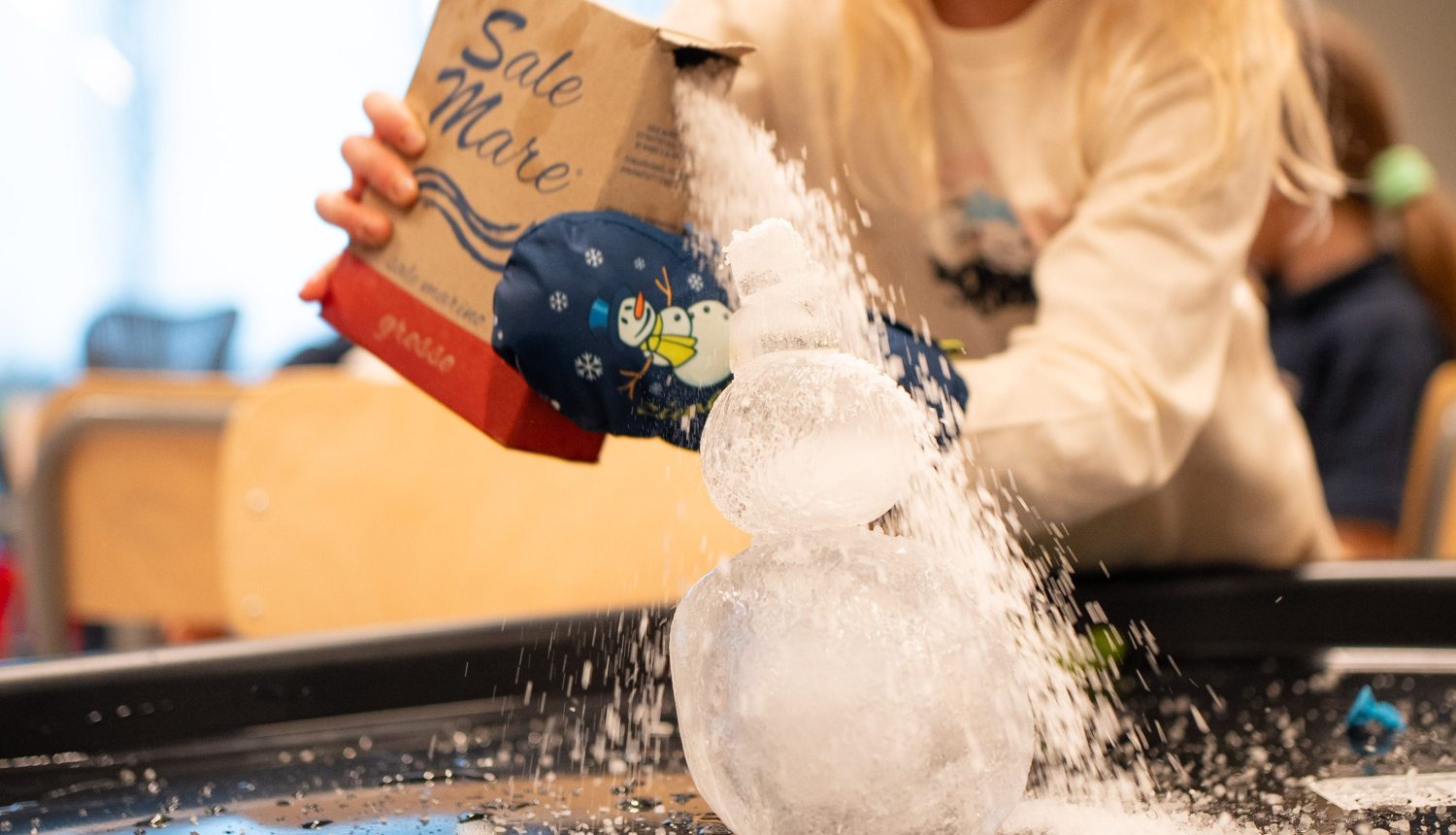
Students were tasked with building ice-people using ice spheres created from balloons frozen the day before. Through trial and error, they discovered that salt could help join the spheres together, slightly melting the surface of the ice and allowing them to “stick.” This process required collaboration, patience, and careful observation. Students learned that experiments are rarely immediate but are built step by step.
Through these experiments, conscious observations emerged: the ice slowly melting, the effect of sunlight, and the time needed for changes to occur. These observations became the basis for reflecting on their results. The reflection phase allowed them to compare what had been observed with their initial questions: which had been answered? What new questions had emerged? In this way, students experienced first-hand how scientific knowledge grows from a continuous cycle of observation, experimentation, and reflection.
Unexpected transformations: from ice to ice cream
Another hands-on experience allowed students to observe changes in the state of matter from a surprising and highly engaging perspective. Using ice and salt to create a very cold environment, they watched liquid ingredients gradually transform into ice cream. Mixing, shaking, and tasting along the way, children experienced science in a playful and memorable way. Concepts like temperature, time, and changes of state became tangible, relatable, and fun.
This activity strengthened the connections between the different learning experiences, turning theory into practice and leaving students with a lasting memory: understanding science through authentic, playful, and deeply meaningful experiences.





 Back
Back

