Exploring science means learning how to look more closely
Have you ever heard of: Trypanosoma brucei gambiense, Ophiocordyceps unilateralis, Toxoplasma Gondii, Chlamydomonas Reinhardtii, or Parenchyma cell?
Yes, they’re hard to pronounce, but incredibly fascinating to explore.
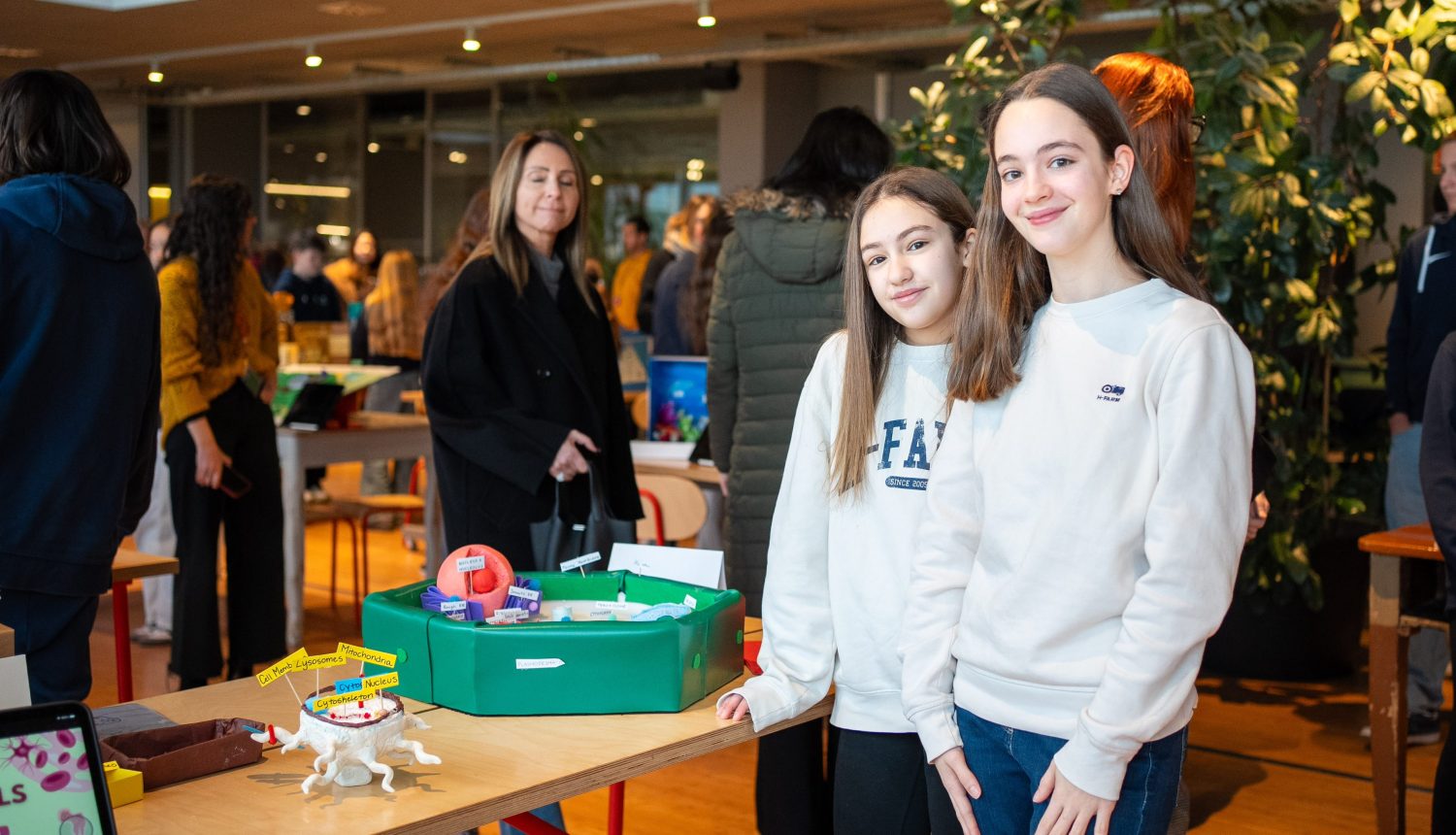
The Science Exhibition by MYP1 and MYP2 students of Venice Campus, transformed our school into a space of scientific exploration, dialogue, and curiosity. An opportunity in which knowledge stepped beyond textbooks to take shape through models, stories, questions, and connections between what we observe every day and what usually remains invisible to our eyes.
Walking among the stands, it was clear that our students’ goal was not simply to present an outcome, but to tell the story of their learning journey. Each project carried the marks of time spent understanding, making mistakes, and trying again. Science did not appear as a fixed truth, but as a living process shaped by experimentation and intuition.
MYP1 students guided visitors through three-dimensional ecosystems, explaining the delicate balance that connects habitats, organisms, and energy flows. Through tangible models, they illustrated how biotic and abiotic factors constantly interact, how plants and animals develop adaptations to survive, and how human intervention can, depending on the choices made, become either a source of imbalance or an opportunity for protection.
From the open spaces of ecosystems, the focus then narrowed to the invisible world of cells. MYP2 students selected a specific type of cell and studied it in depth, learning to recognise its structure, functions, and possible dysfunctions.
To tell their stories, students built detailed models, experimenting with different materials and creative solutions to represent complex elements. Every decision: a shape, a colour, a texture, stemmed from a guiding question: what is the most effective way to make visible what cannot be observed with the naked eye?
Within this process, scientific accuracy met ingenuity, and creativity became an integral part of learning. Understanding also meant translating complexity, simplifying without losing rigor, and finding a language that could truly be shared with others.
The projects were presented to students, parents, and teachers, turning the exhibition into a moment of genuine exchange. Not just a display, but a dialogue: explaining, answering questions, and reshaping one’s thinking through the perspective of those listening.
In this ongoing conversation, some projects invited visitors to pause and look more closely.
One of them led into the microscopic world of parasites. Through her model of Trypanosoma brucei gambiense, our student Caterina explained how a single-celled organism can be responsible for sleeping sickness, guiding the audience through its internal structures and showing how what we cannot see can still have profound effects on human health.
A few steps away, the perspective widened dramatically. The detailed model of the Everglades wetlands made by Leonardo brought attention back to the complexity of natural ecosystems. Animals, water systems, and interconnected environments became tools to reflect on biodiversity and on the importance of understanding nature as a fragile system, one that must first be understood before it can be protected.
Another project stood out for the strength of its biological story and the originality of its materials. Through his model of Ophiocordyceps unilateralis, a parasitic fungus known for its ability to infect ants, Vladimir explored themes of adaptation and survival, transforming a complex cellular structure into something tangible, visible, and unexpectedly close.
Three different examples, united by the same attitude: observing, asking questions, and finding a personal way to tell the story of science.
Bringing the journey to a close, the contribution of our partner Applied Materials offered a perspective that connected students’ work with the world of cutting-edge scientific research and technological innovation. Starting from the cell, the smallest unit of life, the reflection moved toward a different scale: the nanosphere.
It is at this level that Applied Materials operates, developing materials engineering technologies used in the production of chips. Tiny yet essential components that also enable advanced microscopes, fundamental tools for observing and studying the very cells explored by the students.
This shift in scale highlighted how science is a system of continuous connections: what is studied in the classroom speaks to what happens in laboratories, and what is infinitely small can have an enormous impact on our ability to understand life.
The Science Exhibition ultimately conveyed the deepest meaning of learning: not accumulating answers, but learning how to look more closely. Because often, what holds the world together is not what we see at first glance, but what we slowly learn to recognise.





 Back
Back

