Federico Faggin Returns to H-FARM: When Silicon Meets Consciousness
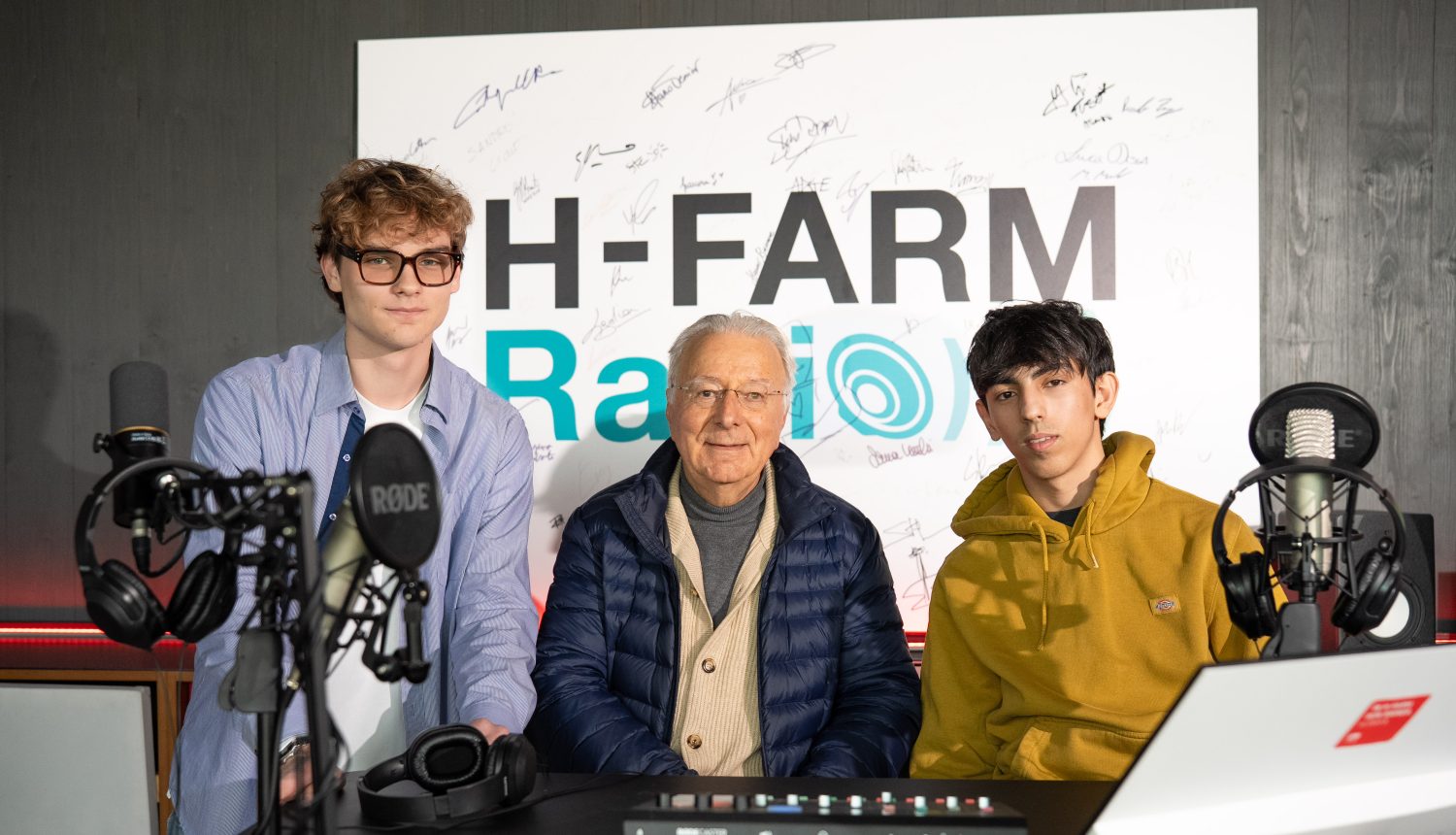
Welcoming Federico Faggin back to our campus is always something special. Not only because he is one of the key figures behind the technological revolution that changed the world, but also because each of his visits brings with it a broader reflection: on the meaning of technology, the role of human beings, and the future we are building.
“The meaning comes before the symbol. We start with meaning, and then we use symbols to express it.”
With this reflection, Federico Faggin invited our students to look beyond technology and question what truly makes the human experience unique.
During his visit to the campus, two DP students, Alex and Aleksandrs, had the opportunity to interview him in the studios of H-FARM Radio. What began as a conversation about technology soon evolved into something deeper: a dialogue about meaning, consciousness, and the future of humanity in a world increasingly shaped by algorithms.
According to Faggin, truly understanding technology also means recognizing its limits. Computers can process information, recognize patterns, write texts, and simulate human behavior. But all of this takes place within a system of symbols.
“A computer can imitate understanding, but it will never truly understand,” he explained. “Understanding comes from experience, from feeling.”
For a machine, words remain symbols that follow formal rules. For human beings, however, they are connected to something much deeper: lived experience.
This means that realities such as love, joy, or empathy cannot be reduced to code or algorithms. We can say “I love you,” but words are only symbols: the experience behind those words belongs solely to the person who lives it.
From the Microprocessor to the Question of Consciousness
Federico Faggin is not only a thinker about technology, he is one of its pioneers.
Born in Vicenza in 1941 and a graduate in Physics from the University of Padua, he is recognized as one of the fathers of modern microelectronics. In the early 1970s, he led at Intel the development of the world’s first commercial microprocessor, the Intel 4004, turning into reality the idea that the power of an entire architecture could be contained within a fragment of silicon.
That breakthrough paved the way for personal computers, smartphones, and most of the devices that are now part of our daily lives. Its impact was so profound that it earned him some of the most prestigious international honors, including the National Medal of Technology and Innovation.
Yet it is precisely the experience of someone who helped build the foundations of the digital age that led Faggin to ask an even more fundamental question: what is consciousness?
We Are Not Machines
In recent years, Faggin has developed a reflection that brings together science, philosophy, and personal experience. At its core lies a simple yet radical idea: the human being cannot be reduced to a biological machine that processes information.
During his conversation with Anthony Saccon, Director of the Foundation H for Human, he summarized this vision in very clear terms:
“You are not the body. You are much more than the body.”
According to Faggin, what we call the “self” does not coincide with the physical body, but with a dimension of experience that uses the body as a tool for knowing the world.
This also means taking on a personal responsibility: learning to look within ourselves in order to understand who we truly are.
“Inside us we have the answer,” he explained. “Not outside.”
A Return That Continues to Inspire
In an era in which artificial intelligence is rapidly transforming the way we work, communicate, and learn, Faggin’s invitation to all of us is to look at technology with different eyes: recognizing, on the one hand, its extraordinary ability to expand what we can do, while remembering, on the other, that the greatest value remains what no machine can replicate: consciousness, experience, and meaning.For us at H-FARM International School, having the opportunity to welcome back to our campus an inspiring model and a brilliant physicist like Faggin and allowing our students to engage directly with him, means far more than hosting a leading protagonist in the history of innovation. It means offering our students the chance to confront a fundamental question for the future: in an increasingly technological world, what does it truly mean to be human?



 Back
Back

