H-FARM International School and Local Schools: United Through Science
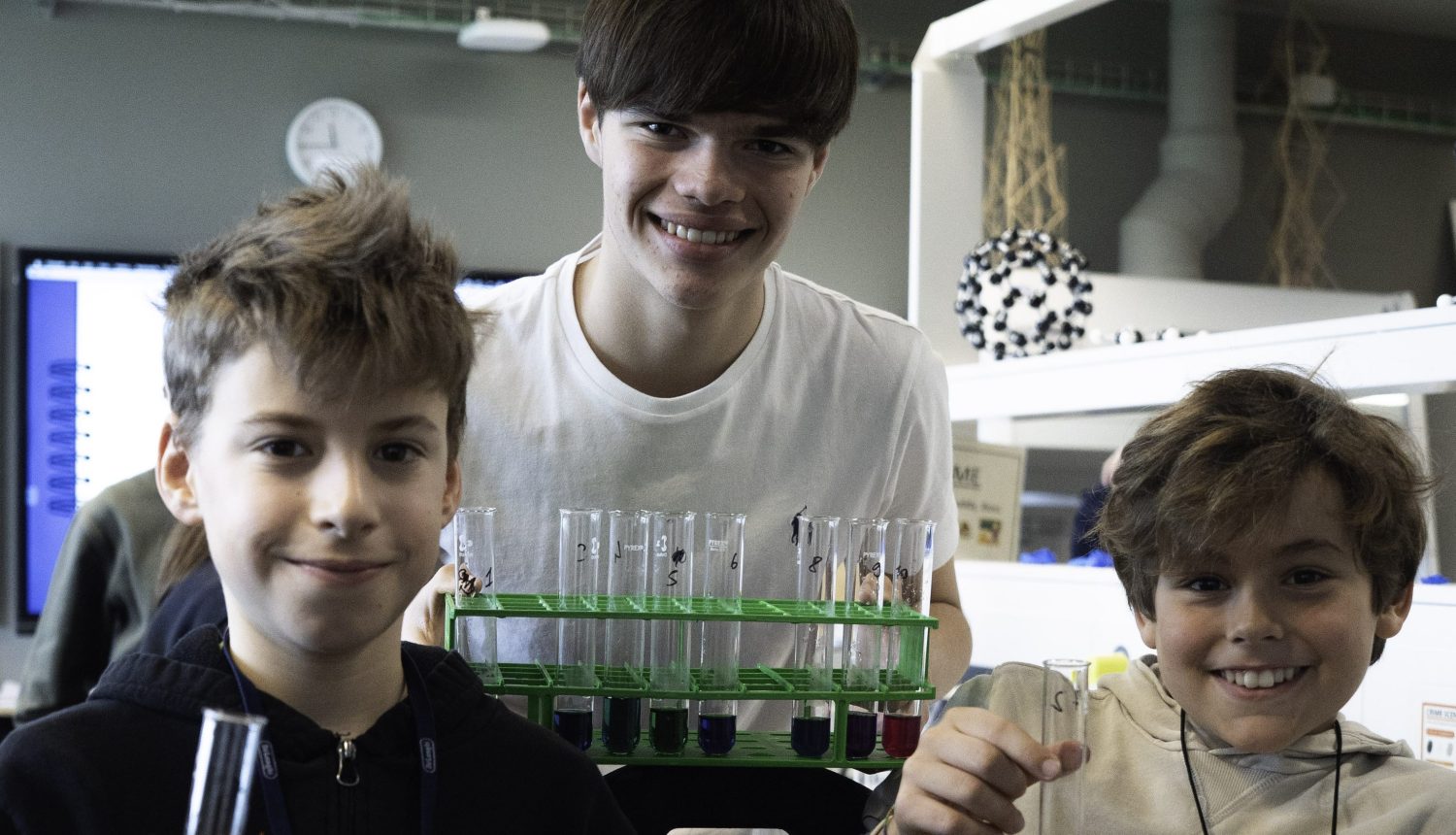
Over the course of this week, the MYP laboratories at our school were transformed into a vibrant space of discovery, welcoming around 150 students from local public primary schools: the fourth and fifth grades from G. Marconi in Monastier and the fifth grades from R. Selvatico in Roncade. The initiative, part of the project “H-FARM and Local Public Schools: United Through Science,” has reached its third edition this year, confirming its role as a meaningful moment of connection between our school community and local schools.
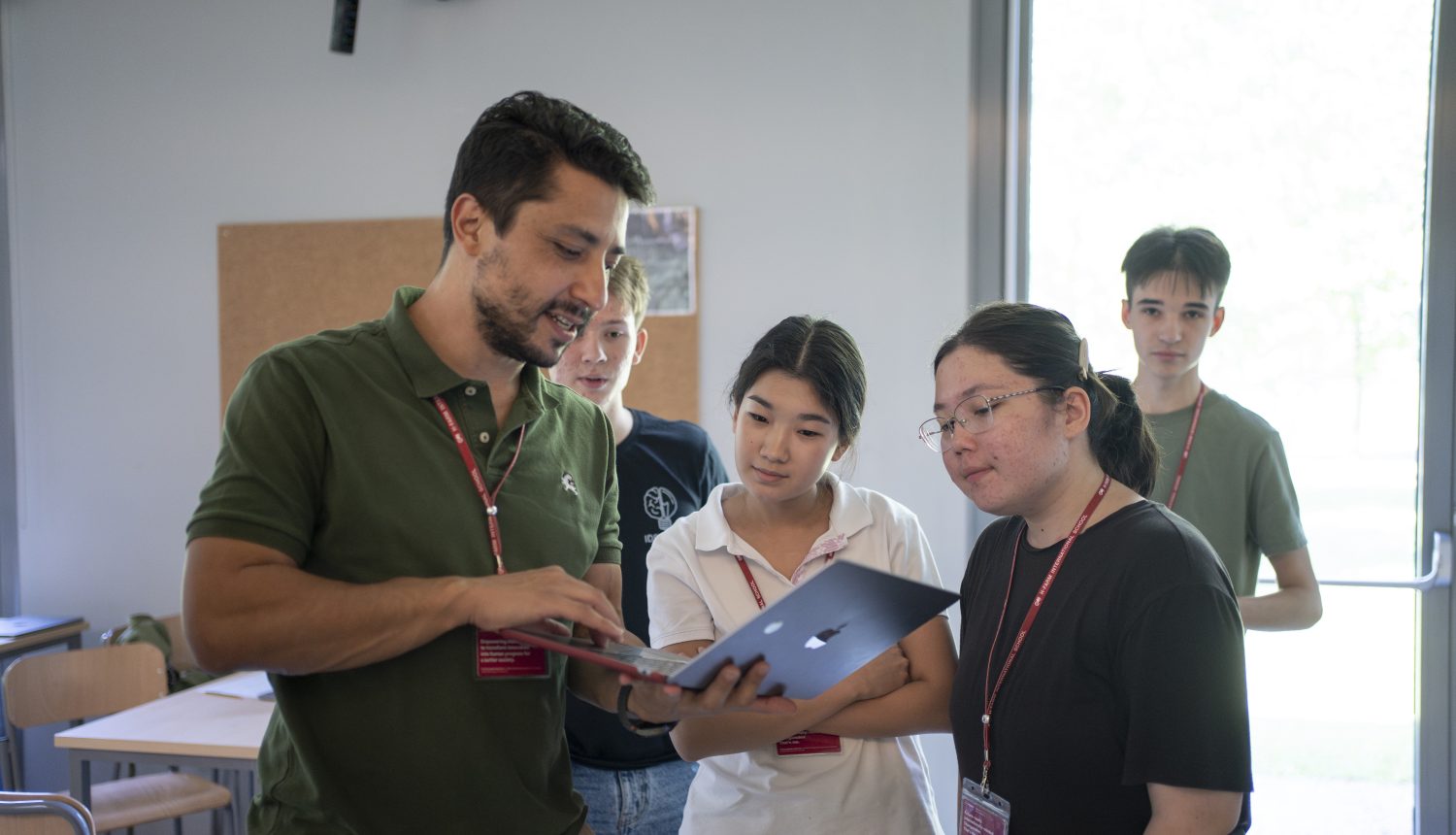
For this occasion, we invited some of our MYP and DP students to participate as Laboratory Assistants, recognizing their commitment and the excellent results they achieved during the first semester in science subjects. These students had the opportunity to work alongside teachers and laboratory technicians, guiding younger participants through the experimental activities and helping make the experience both engaging and accessible.
During these days, the visiting students explored the world of Chemistry and Biology through hands-on activities and laboratory demonstrations. Our students played a key role: they guided groups through the various experiments, explained the scientific phenomena being observed, and encouraged the participants’ curiosity.
In one of the chemistry laboratories, students carried out a fascinating experiment using red cabbage as a natural pH indicator. After preparing an extract from the plant, the resulting purple liquid was distributed into several test tubes containing everyday substances. As soon as the extract came into contact with each substance, the color changed immediately: bright pink in the presence of acidic substances, and blue or green with basic ones.
This phenomenon is due to the presence of natural pigments called anthocyanins, molecules that are sensitive to the acidity of their environment. For the children, it was particularly fascinating to observe how the same solution could turn into a true “chemical palette,” shifting from one shade to another simply by changing the substance it came into contact with. The experiment allowed them to discover in a tangible way that many substances in everyday life have different chemical properties, and that these properties can be observed using simple but effective tools.
In another laboratory, dedicated to biology, participants explored the invisible world through the use of the microscope. Among the samples they observed were onion epidermis, with its orderly and regular structure; potato cells containing starch, where small storage granules could be identified within the plant tissue; and even a bee’s leg, which surprised students with the complexity of its shapes and the details that remain completely hidden to the naked eye.
Alongside these samples, some groups also examined specimens such as sunflower stem and pine stem, discovering how nature, even in its smallest structures, is built according to remarkable patterns, symmetries, and geometries. Looking through the microscope helped students realize that what may appear simple or uniform can actually reveal an unexpected richness of details, patterns, and organization. In this journey into the microscopic world, every slide became a small exploration and every observation opened the door to new questions.
One of the most meaningful aspects of the initiative was the direct dialogue between students of different ages. Our Laboratory Assistants did more than simply explain the experiments: they guided the younger students step by step through the process of observation and discovery. They encouraged them to formulate hypotheses, compare results, and ask themselves why colors changed or why certain shapes appeared under the microscope.
The enthusiasm of the children captured the true spirit of these days. One student, leaving the laboratory, said, “When I grow up, I want to be a scientist,” turning a morning of activities into a declaration about the future. Another, looking around at the laboratories, the equipment, and the students at work, spontaneously commented, “This is amazing! I want to come study here next year!” These words convey better than any description how a hands-on experience can leave a lasting impression.
Opening our laboratories to younger students meant sharing not only experiments, but also enthusiasm, curiosity, and a spirit of collaboration. Initiatives like this strengthen our connection with the local community and remind us how science can become a common language, one capable of bringing together students of different ages through the shared desire to discover and understand the world around us.





 Back
Back

