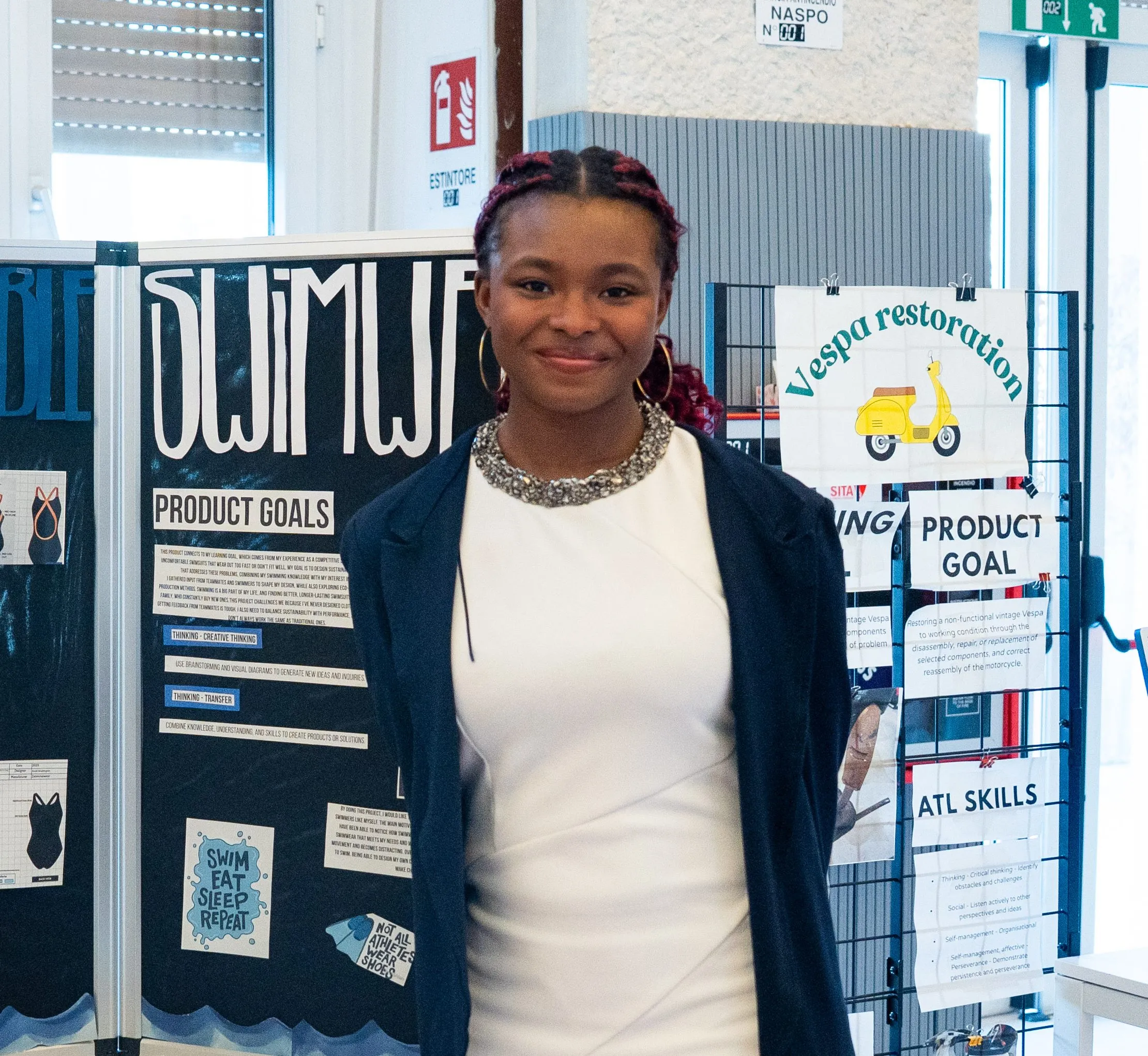

Daily training, competitions, hours in the water and then always the same ending: a swimsuit that loosens, loses its shape, stops performing the way it should and, inevitably, gets thrown away: accurate representation of what happens to countless swimmers like Aniah.
Tired of accepting this as simply “part of the deal,” she began thinking about a way to solve the problem, creating, for her MYP5 Personal Project, a swimsuit that is both durable and sustainable.
Because when you spend that much time in the water, a swimsuit is not just something you wear. It’s what allows you to move with confidence, to focus, to perform. It becomes part of the movement itself, part of the rhythm, part of the trust you carry with you every time you dive in.
And that’s exactly why, when it stops working, it’s not a minor detail. It’s a problem.
A shared Problem
This is where it all begins.
She started by observing herself but above all, others. Teammates constantly adjusting their swimsuits during training, straps leaving marks on the skin after hours in the water, fabrics that lose their shape far too quickly.
Aniah, MYP Student
“I noticed many swimsuits and competitive gear are not eco-friendly, and I would like to learn how to create something that benefits swimmers but also the ecosystem.”
What at first seems like a personal frustration gradually reveals itself as something bigger: a system that doesn’t truly work for those who rely on it every day.
Aniah quickly realizes that it’s not about adding one more feature, but about bringing together elements that are often in conflict: comfort and durability; performance and sustainability; elasticity and resistance. Because “if swimsuits are more sustainable but slow swimmers down, they simply won’t be adopted”.
This awareness pushes her beyond theory, toward a much more structured direction, one that actually has to work in practice.
Finding a balance between performance and sustainability
At this point, she builds a real research path, dividing the work into clear phases. She starts with materials, analyzing eco-friendly alternatives such as regenerated nylon ECONYL, bamboo, and organic cotton, comparing them with the traditional synthetic fibers used in technical swimwear.
Elasticity, shape retention, resistance to chlorine and saltwater, drying time, breathability: these are not secondary features, but essential factors for a high-performance competitive product.
And yet, more elastic materials are often more comfortable but tend to wear out faster. More durable ones, on the other hand, can be less adaptable to the body.
What’s needed is balance, like in most things in life.
At the same time, she expands her research to production. She studies supply chains, certifications, industrial processes, packaging, and even the product’s end-of-life. She doesn’t just want to design an object, but to understand the entire system that makes it possible.
And along this path, challenges emerge.
In her process journal, she describes how difficult it was to navigate often conflicting information, materials that appear sustainable but aren’t truly so, and promising solutions that are hard to apply in reality.
“Sometimes it felt overwhelming,” she writes, “because every solution created another problem.”


But that is exactly where the project begins to grow.
Instead of stopping, Aniah keeps testing, comparing, asking questions. She interviews other swimmers and gathers very concrete feedback: the swimsuit must be snug, but not too rigid; it must support without restricting; it must withstand water without creating unnecessary drag.
And from this information, she begins to design.
Through sketches, form studies, and digital simulations, she develops different versions of the swimsuit. She works on proportions, fit, and tension distribution. She introduces technical solutions such as reinforced cross-straps to improve shoulder stability, compression zones to support the body during movement, and stretch zones to ensure freedom.
Even the cut is designed with performance in mind: a high-leg cut to reduce drag, clean lines to improve hydrodynamics.

The choice of materials reflects the same approach:
78% recycled polyamide ECONYL (a type of 100% regenerated nylon yarn made by recovering waste such as fishing nets, old carpets, and industrial scraps. It is a sustainable, circular fiber, infinitely recyclable without losing quality, significantly reducing environmental impact compared to virgin petroleum-based nylon).
22% extra-life elastane (a stretch fiber produced according to strict textile reuse standards. Thanks to this choice, the need for new plastic-based resources is reduced, aligning perfectly with the goal of minimizing the environmental impact of high-performance swimwear).
A combination that aims to maintain high performance without compromising sustainability.
But designing a good product doesn’t just mean choosing materials and shapes. It means understanding whether that product can truly exist beyond an idea.


From concept to reality: prototypes and real-world challenges
She expands the project into production, beginning to look for suppliers, study companies, and compare real-world possibilities. She even identifies factories in Morocco as potential production partners, trying to understand where and how the swimsuit could be manufactured on a larger scale.
Perhaps we are still far from seeing this swimsuit in stores, but she didn’t want the project to remain purely theoretical. That’s why she decided to build her first prototype. She cuts the fabrics, assembles the pieces, and tests the fit. Some more technically complex elements are entrusted to those with specific sewing expertise, but everything else she creates herself.
Here too, new challenges emerge. Materials don’t always behave as expected. Tension changes once worn. A design that works on paper must be adapted to the real body.
And yet, it is precisely through these continuous attempts that the project truly begins to work. Because every mistake corrects something, and each version gets a little closer to what she had envisioned.
And in the end, something really does change, proving that even what seems like “part of the system” can be rethought.


 Back
Back

