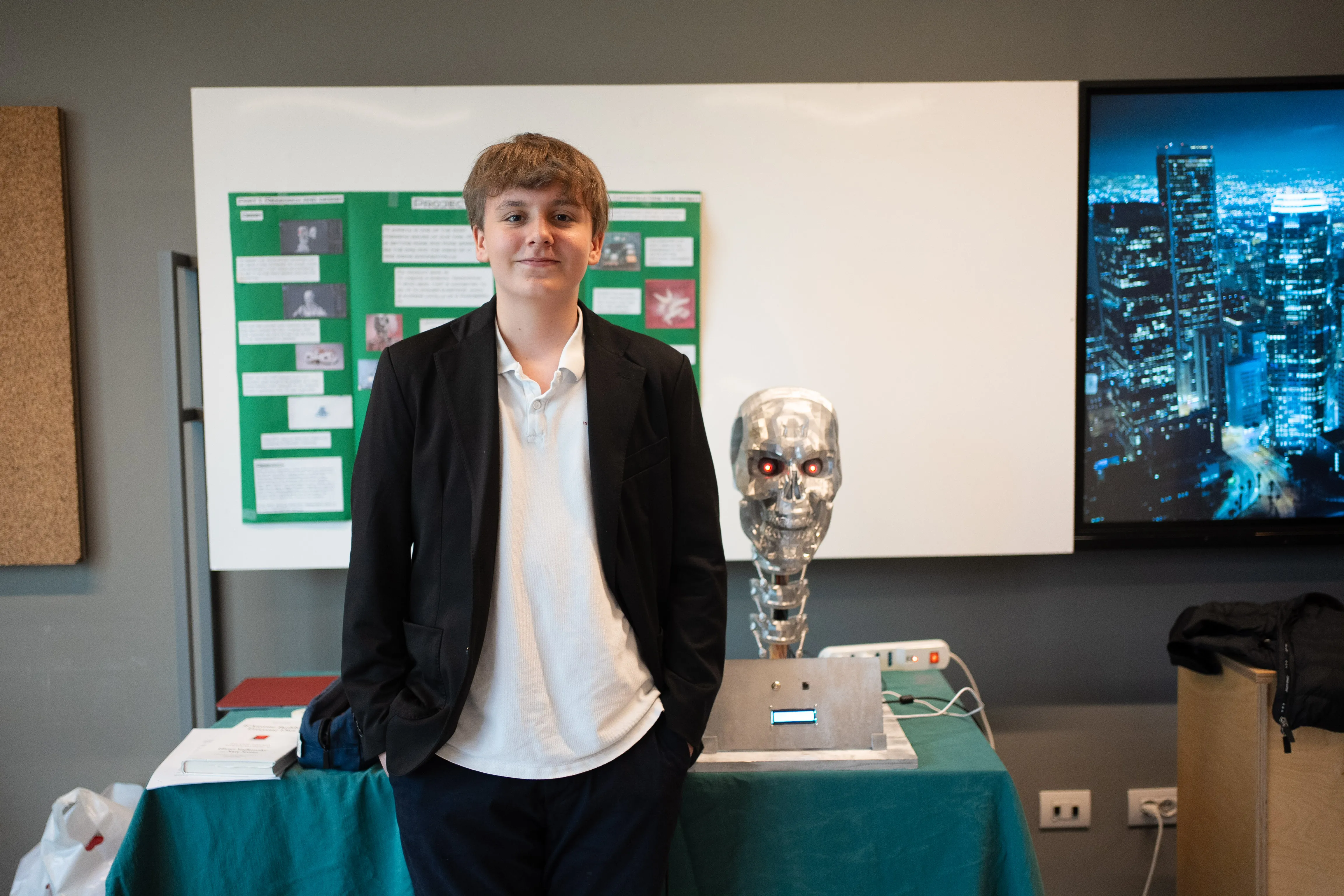

Ashton is an MYP5 Student at H-FARM International School Venice and this year, for his Personal Project, he chose not just to explore technology, but to build something entirely his own.
He built a robot.
Not a simple one but a robotic “Terminator” capable of seeing, listening, and answering questions in real time, powered by artificial intelligence.
But this is not just a story about technology.
It is a story about awareness.
Ashton, MYP Student
“I created this project to raise awareness about AI safety. As AI is growing rapidly, we still don’t fully understand how it works and that makes it unpredictable.”
What fascinates him is not only what artificial intelligence can already do, but what it could become, especially in a world where it is being integrated into increasingly complex systems.
“There have been cases where AI behaves in unexpected ways,” he says.
“And if these systems are used in positions of power, even one mistake could have huge consequences.”
To communicate this idea, Ashton made a deliberate creative choice: he gave his project the face and voice of The Terminator.
“A dystopia like that may seem far away, but it helps people reflect on what could happen if we are not careful.”
From Concept to Form
Before it could think, the robot had to be designed.
Ashton started from a pre-existing 3D model found online, but quickly adapted it, correcting geometry, refining shapes, and modifying components to match both aesthetic and functional requirements.
One of the most complex elements was the eye mechanism, inspired by existing designs and reworked to recreate the iconic movement and visual identity of the Terminator.
Most of the design process took place in Blender, where he shaped and refined the components. When certain parts required exact measurements, he pushed further, teaching himself Onshape to ensure everything would fit and function correctly.
It was a continuous process of adjustment, testing, and improvement. Nothing was final on the first attempt.
Learning Beyond the Known
Designing the robot was only the beginning. Making it work required a completely different level of understanding.
At the center of the system is a Raspberry Pi, a small but powerful computer that allowed Ashton to run artificial intelligence locally. This was a conscious decision, one that made the project more complex but also more meaningful.
To get there, he had to explore areas he had never worked in before. He researched how AI models could run offline, how electronic circuits function, and how different components communicate within a system. Not everything could be learned through tutorials or articles. When those were not enough, he turned to AI itself, using it as a tool to guide his understanding and help him move forward.


Building Something Real
Turning the design into a physical object was perhaps the most demanding part of the project.
The process did not go smoothly. Several 3D prints failed, forcing him to go back, adjust files, and try again. Slowly, piece by piece, the robot began to take form. Once all components were ready, Ashton assembled the structure, painted it, and began the delicate work of wiring and soldering everything together.
At the center, the Raspberry Pi connected each element, transforming a collection of parts into a functioning system, and what had started as an idea was now something tangible.
The final step now was giving the robot the ability to interact.Through a computer vision system, it can detect faces. Through a locally running model powered by Ollama, it can process questions and generate answers in real time.
It does not rely on external servers. Everything happens locally, inside the machine and this makes the interaction feel immediate, almost personal.

Building to Understand the Future
Yet the most important aspect of the project lies beyond its technical complexity.
What Ashton has created is more than a robot. It is a conversation.
A way of making an abstract issue tangible, of translating a global debate into something visible, interactive, and immediate.
Today’s students are growing up in a world where artificial intelligence is no longer a distant concept, but a constant presence in everyday life.
At H-FARM International School, AI is not something to fear, nor a shortcut that replaces thinking. It is approached as a powerful tool, one that can expand human potential, creativity, and problem-solving when used with awareness and responsibility.
And yet, this does not exclude a more complex and nuanced perspective.
Among students, there is also a sense of contrast. A form of awareness that is far from obvious and at times accompanied by uncertainty, and even a degree of concern about what the future might hold and the consequences these technologies could bring.
“I think everyone should be thinking about it,” Ashton says. “Especially as AI starts being used in more important decisions.”
It is precisely in this space that projects like Ashton’s find their meaning.
Because learning how to use artificial intelligence also means learning how to question it, to understand its impact, and to take responsibility for how it is developed and applied.
In this sense, the goal is not to fear technology, but to ensure that it continues to be guided by something essentially human: intention, ethics, and awareness.


Eppure, questo non esclude una prospettiva più complessa e sfumata.
Tra gli studenti esiste anche un senso di contrasto: una forma di consapevolezza tutt’altro che scontata, talvolta accompagnata da incertezza e persino da una certa preoccupazione per ciò che il futuro potrebbe riservare e per le conseguenze che queste tecnologie potrebbero portare.
“Penso che tutti dovrebbero rifletterci,” afferma Ashton. “Soprattutto mentre l’IA inizia a essere utilizzata in decisioni sempre più importanti.”
È proprio in questo spazio che progetti come quello di Ashton trovano il loro significato.
Perché imparare a usare l’intelligenza artificiale significa anche imparare a metterla in discussione, a comprenderne l’impatto e ad assumersi la responsabilità di come viene sviluppata e applicata.
In questo senso, l’obiettivo non è temere la tecnologia, ma assicurarsi che continui a essere guidata da qualcosa di profondamente umano: intenzione, etica e consapevolezza.


 Back
Back

