Learning Ceramics: Bruno Munari’s Vision
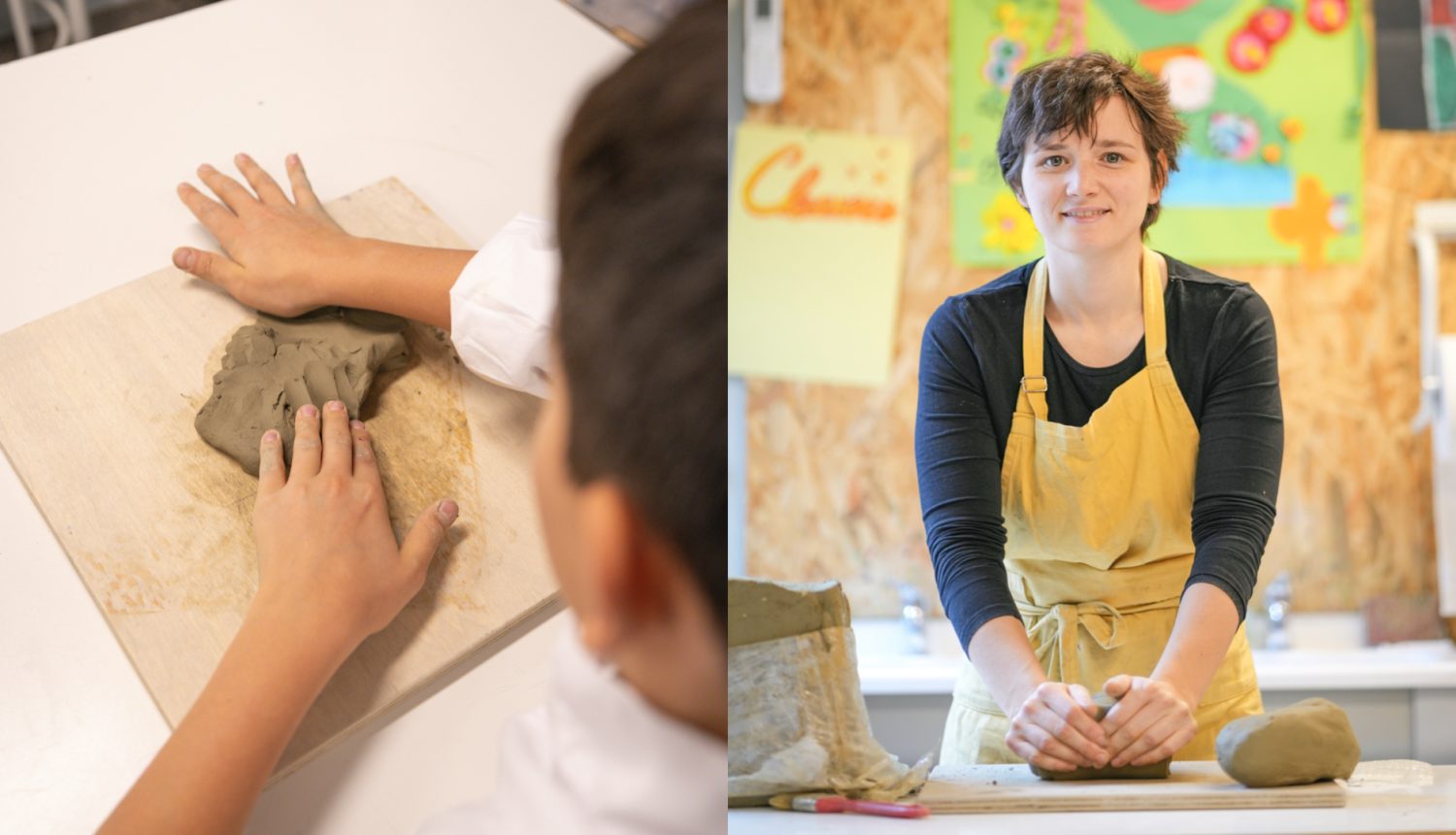
This year again, on our Rosà Campus, our Lower Secondary students took part in three ceramics workshops, one for each year group, led by Sara Dall’Antonia, ceramic artist and educator. The starting point was a simple idea: before making, you have to understand. Sara brought into our classrooms the method of Bruno Munari, one of Italy’s great twentieth-century artists and designers, which invites students to get to know a material before giving it shape: to touch it, observe it and test it, until they understand how it behaves and what it can become.
The guiding principle of the programme is a quote from Munari himself:
«There can be no manipulation, reworking or creativity without knowledge. What matters is not the finished piece, but the journey the child takes to arrive at understanding.»
Three Workshops, Three Themes
Each year group had its own project, with a different theme to explore:
– Lower Secondary 1, “Piastrella” (Tile): students searched for imprints and traces in the clay using objects of every kind, studying shape, repetition, stillness and movement.
– Lower Secondary 2, “Sorprese di Terra” (Surprises from the Earth): students worked with slabs of clay to build a curved sculpture, decorated with different clays pressed into the surface, exploring scale and three-dimensional space.
– Lower Secondary 3, “Città verticali” (Vertical Cities): students built a city out of geometric forms, learning to break down and reassemble shapes and to find balance.
What They Learned
Working with clay allowed our students to develop skills that go well beyond ceramics:
- Independence and responsibility: they managed the material on their own, following a few simple rules.
- Observation and curiosity: they explored the clay through touch, sight and smell, and asked questions to find the answers for themselves.
- Spatial and logical thinking: they broke down and reassembled geometric forms, reasoned in three dimensions and searched for balance.
- Problem solving: to make their constructions stand, they tried, tested and adjusted.
- Planning and patience: they pictured in advance what they wanted to build and respected the time needed for drying and firing.
- Self-awareness: by testing themselves with their hands, they discovered how they learn, how they face a challenge and how they create.
On Display
The beauty of this workshop does not stop at the classroom door. This spring, our students’ work will leave the classroom and be hosted at Spazio Magazzino in Conegliano, a contemporary art space housed in the former Magazzino del Lavoratore, a short walk from Palazzo Sarcinelli, where exhibitions and events bring artists and audiences together. Seeing their creations displayed in a real art space means discovering that what they built with their own hands, one gesture at a time, can be looked at, talked about and shared.






 Back

