How do you turn a great idea into a clear, convincing pitch?
A little sneak peek at three of the projects
Demo Night is only two weeks away, and our MYP4 students are about to step onto the stage that closes a year of work in the Startup Lab. A year of brainstorming, prototyping, pivoting, of ideas that grew, shrank, broke and were rebuilt. Now comes the hardest part: condensing all of that into five minutes that a room full of people, judges, peers, families, can actually understand, remember and care about. And who better to help them rise to the occasion than the team from the Startup Centre?
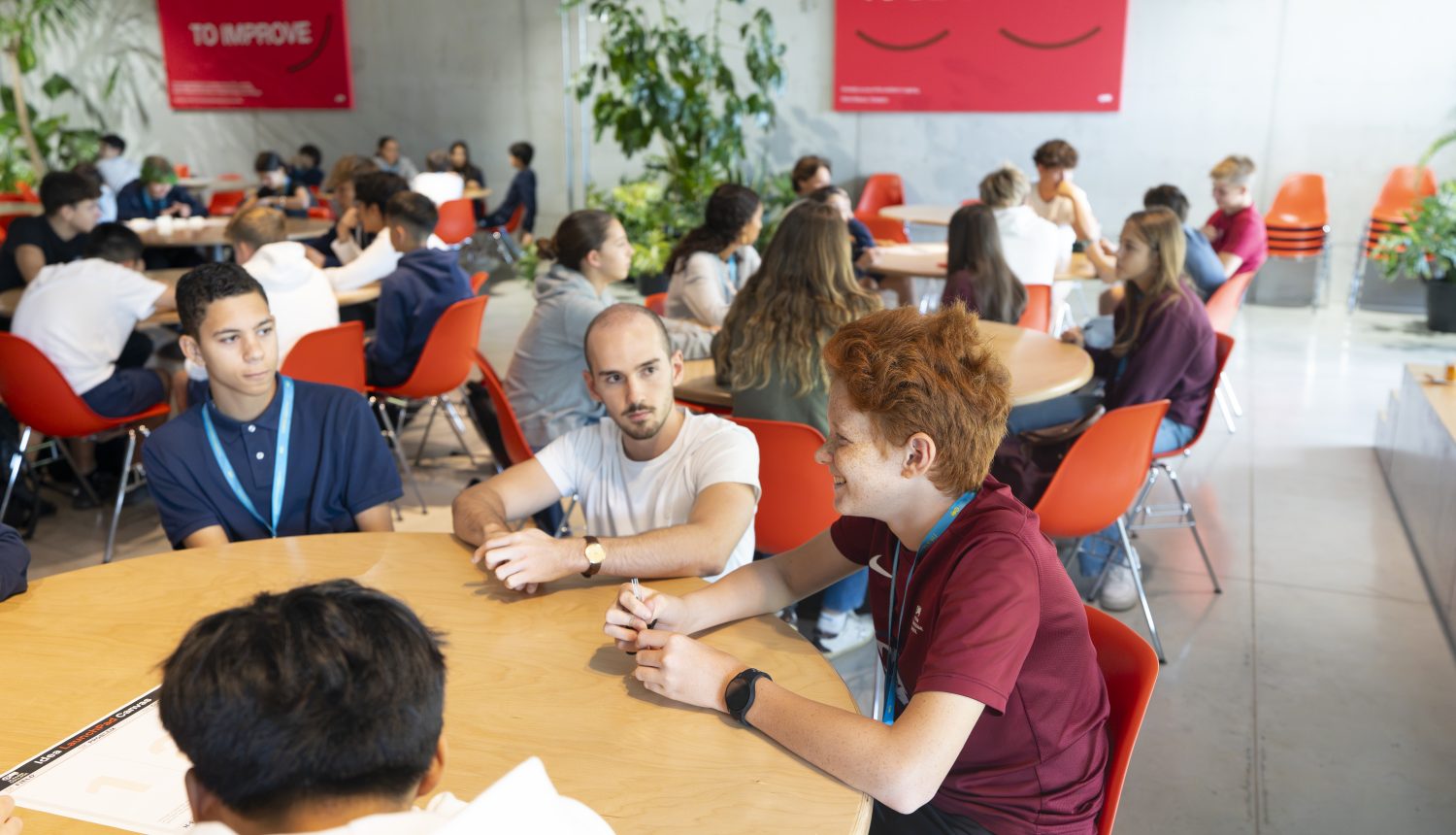
Over two intense sessions, Anna and Corrado, who run real accelerator programs at H-FARM Startup Center, sat down with the students to share the same methods they use with established startups around the world. “There is no groundbreaking truth. There is no one way on how you can do the final pitch deck,” Anna told the class at the start, “but there are sort of guidelines, sort of must-to-have things that I hope you will do right. And if you do so, you are halfway to succeed.” The first meeting was about the theory and architecture of a great pitch; the second turned the spotlight onto the students themselves, who pitched their projects live and received feedback on the spot. Two complementary moments, one shared goal: walking into Demo Night ready.
A great pitch starts with a great understanding of your project
One of the first ideas Anna planted is also the most underestimated. A pitch is not really a communication problem; it’s a clarity problem. “You would never have a coherent pitch if you don’t have a coherent idea and a coherent project,” she explained. The moment you sit down to build your slides, all the weak joints in your thinking become visible: the data you don’t actually have, the assumption nobody ever questioned, the place where you start reading from your notes because you don’t fully believe what you’re saying. In that sense, preparing a pitch is mostly homework on the project itself, and only secondly a matter of design or delivery.
This was also why the team insisted that AI tools, however powerful, are not a shortcut. As Anna put it, “if you don’t have a deep, deep understanding of the connections between the slides, why did you put that piece of data on that slide, what do you want to communicate, then no AI would help you.” But once the logic is solid, AI can do wonders for visuals and layout in minutes. Clarity first, polish later.
Start with the problem. Make people care before you show them the solution.
If there’s one rule the Startup Centre team kept repeating, it’s this one. Audiences don’t fall in love with products, they fall in love with problems they recognise. The point came up again and again during the elevator-pitch exercise that opened the first session, when each team had to describe their project in a single minute. Whenever a team started with “we built an app that…”, Anna gently pulled them back. “Try to start with a problem,” she insisted, “because if I understand that there are so many people who struggle, I would be much more empathetic to a solution you’re building.” Corrado added the same warning from another angle: showing the product too early kills the suspense. “If you show the product or explanation of the product or a demo of the product from the very beginning, like very bluntly, I’m already like, well, I already know why I should listen to it.”
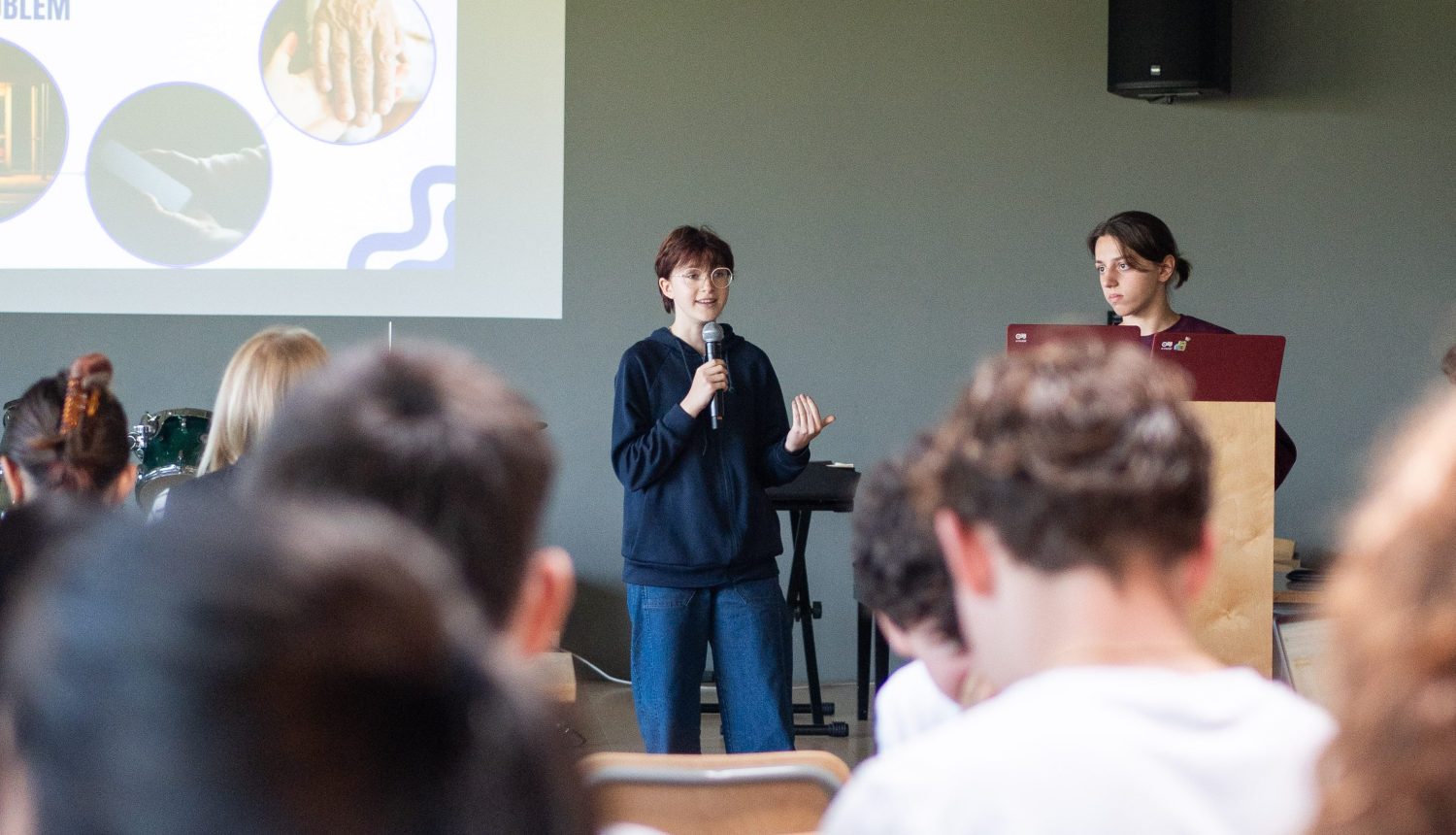
The best illustration of this came from one of the students themselves. When the “Behind the Deal team”, an app for families dealing with Alzheimer’s and dementia, pitched a few days later, they didn’t open with features or numbers. They opened with a Friday night in Chibizo, a school party, a mother and her daughter, and a phone call from a bus stop where a 79-year-old grandmother stood with no coat and no idea where she was. “Most founders build apps because they find a gap in the market,” the student said. “But sometimes you create an app because you were in the gap. That family at that local school hall, that was me and my mother.” The room went quiet. That is what starting with the problem actually looks like, and the feedback afterwards confirmed it: “I love how you presented the problem. It was so good.”
The Grandma Test
Of all the tools Corrado handed the students, one stuck more than the others. He called it the grandma test, and he framed it as the most honest filter a founder can apply to their own work. “When you try to make something, use the test of the grandma. You need to explain things as you explain to your grandma. Slow, confident. But simple, easy to understand.” Grandmas, he insisted, are very important.
The principle came up again and again throughout the session. When a slide had too much text, when a target audience was described with five paragraphs of demographic detail, when a feature list was so technical that even a fellow student couldn’t follow, the team gently pulled the students back to that one question: would your grandma get this? The reference example was Airbnb, whose original solution slide describes the entire company in three short lines. “I don’t have to read even if price is an important concern. I just read the price, hotels, no easy way exists. And already from this, by listening, I can understand what is the problem.” That economy of words is not a stylistic choice; it’s a sign the founders really know what they’ve built.
The same idea returned in a different form when Anna spoke about slides themselves. “Either you listen to me, either you read the slide. Whenever you start to read all those information, you already lost me. Or vice versa. So we should be complimentary. What I’m saying and what is in the slide.” Bullet points crammed with text, in short, are not safety nets, they are competitors to the person speaking.
The anatomy of a pitch
With those principles in place, Corrado walked the students through the storyboard the Startup Centre has distilled from dozens of accelerator programs around the world. Not a rigid template, but a sequence that, in some shape or form, every convincing pitch needs to cover. A few moments deserved particular attention. The problem, ideally anchored in a story, a number, an image or a direct question to the audience, because that is what earns the right to keep talking. The competition slide, where one rule was non-negotiable: never, ever say you have no competitors. “That means basically two things,” Anna explained. “Either you didn’t do the home exercise, or you don’t understand who your competitors are. Because if they don’t do it, meaning there is no problem. Meaning the whole point is not there.” And the call to action, the closing line, which Anna treated almost as a separate art form, because the audience will remember the first and the last slide more than anything in between. “Please don’t close with something, that’s it, thank you, and you go away. Try to find a strong message which could be a call to action, your mission, your statement, whatever you come up with.”
Two weeks before Demo Night: the rehearsal
If the first session was theory, the second was reality. Each team got five minutes to pitch their project to Anna, Corrado, the teachers and their classmates, with immediate feedback after every presentation. Before the pitches started, Anna left the students with one tender piece of advice: record yourselves while rehearsing, listen back, and pay attention to where the filler words appear. Those “uhm”s and “like”s usually show up exactly where you are least sure of what you’re saying and that, more than anything, is a signal to rework that part of the project.
A first look at three of the projects
What follows is just a glimpse of three of the projects that will take the stage at Demo Night.
Three of the projects offered a particularly good window into the variety of ideas the class will bring to the stage on June 4th. LexiPad is a Kindle-like study device designed specifically for dyslexic students, a single tool that gathers what those students usually have to piece together across multiple apps, from adjustable fonts and colours to built-in AI support, a Pomodoro timer and visual filters that ease the familiar struggle of words moving on the page. The idea is simple but quietly radical: a device built for dyslexic students rather than adapted to them.
A similar instinct, building for the people who are usually left to adapt, runs through Safe Street, a safety-navigation app created “by girls, for girls”. Working in the same spirit as Waze or Google Maps but designed for pedestrians, it suggests the safest walking route in real time by combining community reports, police data and street-lighting information, with a simple green-yellow-red code that tells you instantly which streets to take and which to avoid.
If LexiPad and Safe Street start from a deeply personal experience, AQ Aerial takes on a threat most of us never see at all. The team built a drone that, connected via Wi-Fi to a dedicated app, transmits real-time data on air pollutants across large areas, something stationary sensors simply cannot do. Designed for governments, school campuses and industries monitoring their own emissions, it turns invisible threats visible, and gives people most affected by poor air quality, like those suffering from asthma, a tool that finally takes their problem seriously.
What the students are taking with them
Across both sessions, a few threads kept reappearing. That pitching is not a performance bolted onto a project but a stress test of how well you actually understand it. That the audience will give you about one minute before deciding whether to keep listening, so the opening has to earn the rest of the time. That clarity beats cleverness, and a single well-chosen sentence beats a slide full of bullet points. That every team has a strength, a working prototype, deep interviews, a personal story, a clear target and that strength should be the one thing you make sure nobody in the room forgets.
There’s also a quiet message underneath all the technical advice, and Anna voiced it at the end of the rehearsal: “Don’t feel it as a suffering. You’ve been working towards it all this time, and it’s a great moment to actually share and present. No one is there to judge you.” Pitching, she said, is genuinely fun “as soon as you cross the threshold of fear.”
Two weeks to go. The slides will get cleaner, the timing tighter, the stories sharper. The grandma test will be applied many more times. And on June 4th, when our MYP4 students walk onto the Demo Night stage, they won’t just be presenting projects, they will be telling the audience why those projects matter. Which, as Anna and Corrado spent two sessions showing them, is what a great pitch has always been about.





 Back
Back

