Demo Night 2026: when ideas come to life on stage
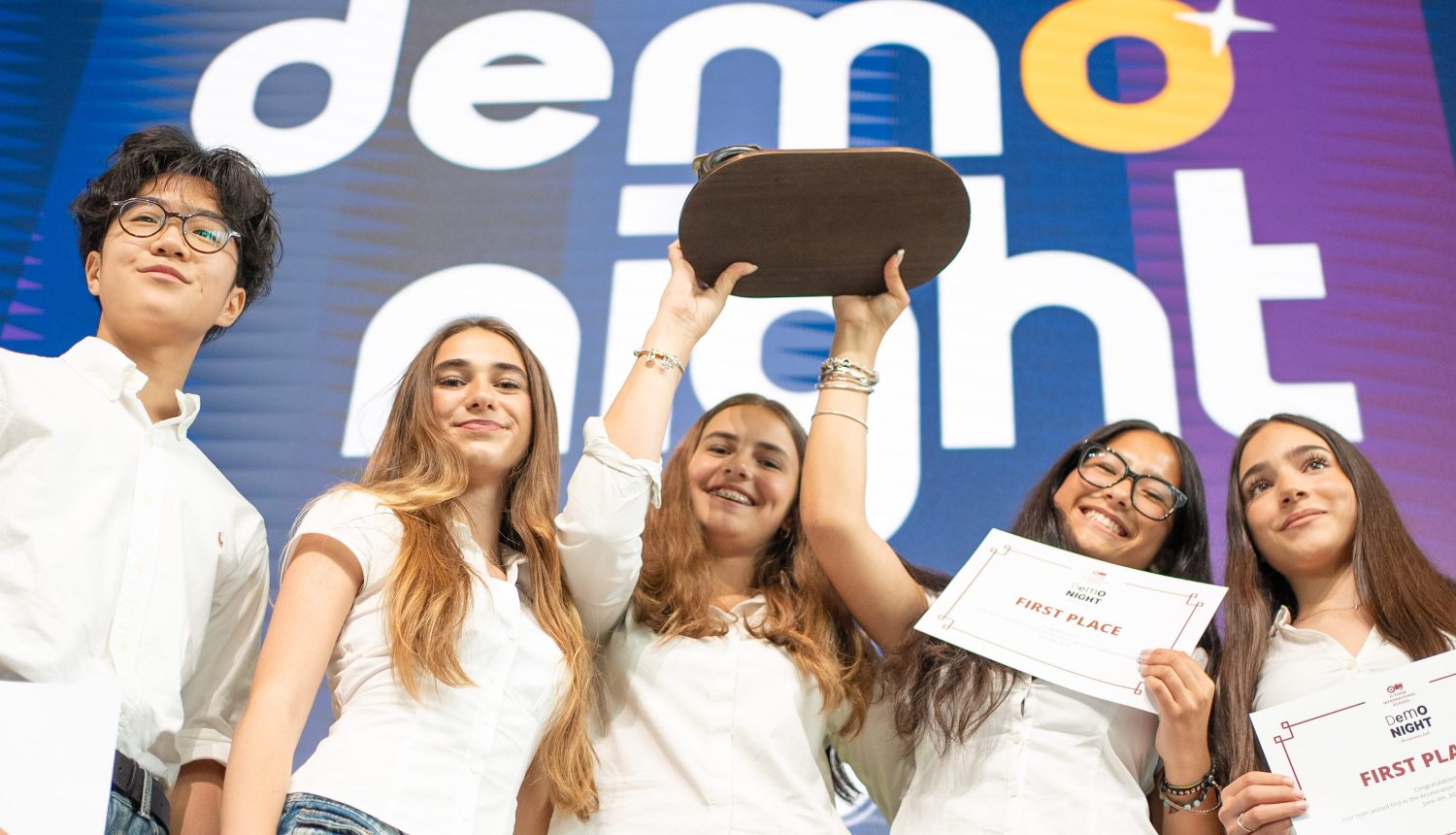
This year, alongside the fifteen teams that took the Demo Night stage, there was an unexpected guest: a dog. Standing next to his fourteen-year-old teammates, with all the dignity of someone who knows they have an important role to play. He was the mascot of VitalCollar, one of the startup projects presented that evening, and probably the only presenter of the night without a single nerve in his body.
Which, honestly, is understandable. Demo Night is a big deal. Every year, it marks the end of a long journey through the Startup Lab: a full year of work, compressed into five minutes on stage. Five minutes to explain the problem you chose to tackle, convince a jury your solution makes sense, and do it all in front of a room full of parents, teachers and guests watching your every move.
Fifteen teams. Fifteen problems chosen, researched, and addressed. Some ambitious: a helmet that reads brainwaves, a device built for students with dyslexia, an app that maps street safety at night. Others more grounded: a marketplace for used school materials, a directional light for ski poles. The raw material was the same for everyone: an observation about the real world, and the question that followed. Why doesn’t this work better yet?
One of the most personal pitches of the evening was DEAL. Elisa, one of the students on the team, opened with the story of a real event: her grandmother found alone at a bus stop, disoriented, without keys, miles from home. “I realized that love wasn’t enough to protect her, but technology can.” From that moment came the idea for an app to support caregivers of people with dementia and Alzheimer’s: medication management, transport, and practical assistance for those who look after someone else every single day, because “dementia doesn’t affect just one person. It reshapes entire families.” The project doesn’t claim to solve everything. But to take some weight off the shoulders of those already carrying too much, yes.
Another project rooted in an uncomfortable truth was SafeStreet. In 2023, 40% of people reported not feeling safe walking alone. The team’s answer is a navigation app that works like Waze, but instead of traffic, it maps street safety: user reports, police data, and lighting quality combine to mark routes in green, yellow, or red.
On the more technologically ambitious end, Encephalon Safety presented a helmet, the “NeuroHat”, capable of monitoring brain activity and sending an alert before an epileptic seizure or stroke occurs. The team was honest about the road ahead: it may take time before a device like this becomes commercially viable, it might change shape, it might eventually become something far more discreet. But the core idea of acting before something happens, rather than after, is conceptually strong, and it was enough to convince the jury to award them second place.


Not every project was looking to solve large-scale problems. Some started from much more everyday frustrations. EduSwap imagined an in-school marketplace where students can buy, sell, or swap used school materials: books, uniforms, stationery. A simple idea, with a clear economic logic and a real impact on family budgets. Skiblink, on the other hand, tackled something no one had addressed on the ski slopes before: the lack of communication between skiers. A device attached to ski poles that signals your direction with a light, much like a car indicator, but on the mountain. Brutally simple, as the team put it themselves. And perhaps precisely because of that, hard to dismiss.
Back to our four-legged guest: VitalCollar, the smart collar with GPS, health sensors, and real-time activity monitoring designed for older and more fragile dogs, won the popular vote from the audience and took third place in the jury’s rankings.
Second place went to Encephalon Safety, recognised for the innovative potential of their idea. The Golden Tractor Award 2026, the most anticipated recognition of the evening, was given to LexiPad. The project starts from a precise observation: traditional study tools were not designed for students with dyslexia, and those who have it end up spending years adapting to technology that never meets them halfway. LexiPad wants to reverse that logic. It is a study tablet built from the ground up exclusively for dyslexic students, combining customisable fonts, text-to-speech, visual filters, document scanning, and AI tools capable of summarising complex texts, explaining diagrams, and helping with study planning. Not a generic product with a few accessibility features bolted on as an afterthought, but a device where every design decision starts from a real need. “Learn your way, not the other way.” The jury recognised the strength of the social impact and the clarity of the vision. It is hard to disagree.
Demo Night is not a showcase of finished products. It is a snapshot of a process, of a year spent asking questions, searching for answers, and building something from scratch. The fact that fifteen groups of students stepped onto that stage and looked a room full of adults in the eye while presenting an idea is, in itself, the most important result.
A result that would not have been possible without the people who supported these students from beginning to end. A special thank you goes to business and economics teacher Alberto Castillo, who coordinates the Startup Lab course and guided every team through the entire journey, from the very first half-formed ideas all the way to the stage, and to the teachers who supported him along the way, Attilia Ruzzene and Peter Williams. And to the guests and mentors he brought with him, who were essential in inspiring and guiding the students throughout the process: Allegra Masciarelli, Zeno Tosoni, Timothy ‘O Connell, Anna and Corrado from the H-FARM Startup Centre, Matilda Abbiati, Emerson Fittipaldi, George and Domenica Watkins, and Professor Pierluigi Fasano.Thank you to the jury, the parents, and all the guests who made the evening what it was. And thank you, above all, to the students, for the courage to get up on that stage, and for everything they put in before getting there.





 Back
Back

